
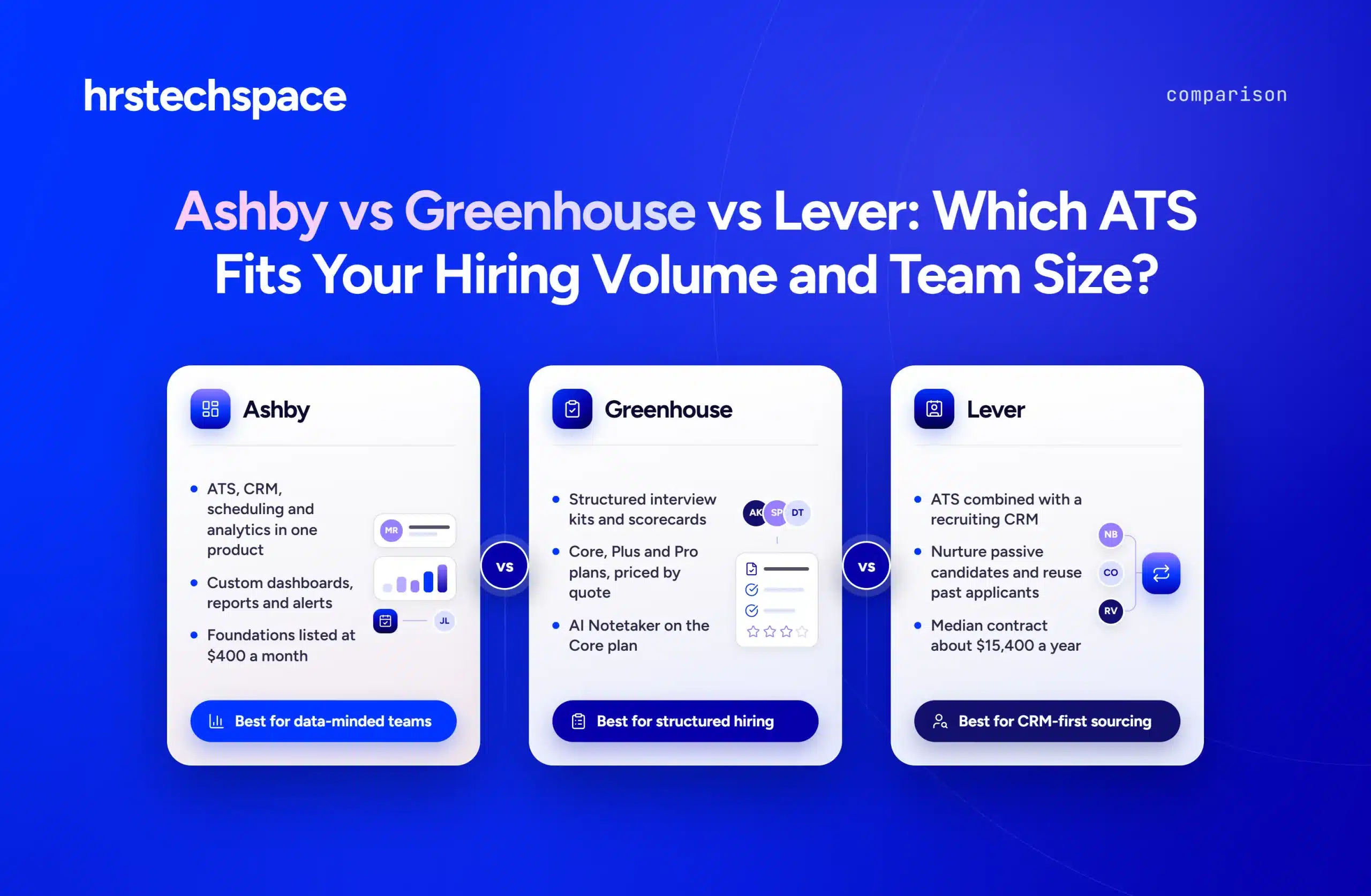
Talent leaders rarely shortlist the wrong applicant tracking system. They shortlist three good ones and then struggle to tell them apart, because the feature lists now overlap almost completely. Ashby, Greenhouse, and Lever all offer sourcing, a candidate CRM, interview scheduling, AI assistance, and reporting. Read the three pricing pages side by side, and the same words appear on each, which is why so many Ashby vs. Greenhouse comparisons end in a tie.
The differences that decide whether a rollout succeeds sit underneath those lists: what each product was designed around, how much configuration and admin it expects, which features sit in the base plan and which arrive as add-ons, and how it behaves when hiring volume doubles. This guide works through those differences. It starts with the Ashby vs. Greenhouse comparison, the pairing buyers search for most, then brings Lever in, and ends with a fit guide by company stage and a two-week evaluation plan you can run before signing.
| Quick verdict: Choose Greenhouse if you want a structured, consistent interview process across many teams and locations. Choose Lever if you hire the same roles repeatedly and want a candidate CRM at the center. Choose Ashby if you want ATS, CRM, scheduling, and deep analytics in one product, especially as a fast-growing company with a data-minded recruiting team. Ashby is the only one of the three that publishes a starting price. |
Start with the problem you are hiring the ATS to fix.
Most ATS replacements are triggered by one dominant frustration, and that frustration is the best predictor of which product will feel like an upgrade. Before any demo, ask your recruiting team which of these sounds most like their week:
- “Every hiring manager interviews differently, and we cannot compare candidates fairly. ” That is a process consistency problem, the problem Greenhouse was designed to solve.
- “We keep sourcing from scratch for roles we filled six months ago.” That is a pipeline reuse problem, where Lever’s CRM-first design is strongest.
- “Our reporting lives in spreadsheets, and leadership asks questions we cannot answer quickly.” That is a data problem, which is Ashby’s main argument.
- “We run five tools for sourcing, scheduling, the ATS, and reporting.” That is a consolidation problem. Ashby is built as one product, and Greenhouse and Lever both bundle more than they used to.
Write the answer down and score every demo against it. Feature parity makes it easy to drift toward whichever vendor gives the most polished presentation.
What each one was built to do
Greenhouse: structured hiring first
Greenhouse built its reputation on structured hiring: interview kits, scorecards, and agreed evaluation criteria for every role so that each interviewer assesses the same attributes. Its pricing page shows three plans that build on each other. Core covers sourcing and CRM, structured interview kits and scorecards, scheduling, reporting, single sign-on, an AI Notetaker, and talent matching. Plus adds AI-powered report filters, a business intelligence connector, sourcing automation, texting, and fraud and spam detection. Pro adds unlimited CRM events, enterprise data configuration and security, an audit log, and a developer sandbox.
Greenhouse also uses AI to suggest scorecard attributes, interview questions, and job post wording on its Core plan, which helps teams set up structured processes faster. The plan progression tells you who Greenhouse expects to grow into Pro: companies operating across regions and business units that need governance and auditability.
Lever: a recruiting CRM at the center
Lever combined an ATS with a recruiting CRM from the start. Candidate records persist across roles, talent pools can be nurtured with automated follow-up, and past applicants become the first place to look when a similar role opens. Lever is owned by Employ, which acquired it in 2022 and also owns Jobvite and JazzHR.
Its built-in AI includes Talent Fit, which ranks applicants against criteria recruiters set, interview transcripts and summaries, engagement alerts when a candidate’s interest seems to be fading, AI-drafted feedback for rejected candidates, and fraud signals that flag identity or document mismatches. Several AI tools are sold separately, including AI Screening by VONQ, Employ Interview Intelligence, and Candidate Insights for assessments and reference checks.
Ashby: one product for the whole recruiting function
Ashby was built as a single product covering the ATS, CRM, and sourcing, scheduling, and analytics, rather than an ATS with modules added later. Its pricing page splits plans by company size: Foundations for up to 100 employees, Plus for 101 to 1,000, and Enterprise for larger organizations. It also sells Ashby Analytics on its own to companies with 100 or more employees that want to keep their existing ATS.
Ashby lists AI features across almost every step: candidate search and outreach personalization, application review, talent rediscovery, interview summaries, report interpretation, custom AI agents, and an MCP server for connecting other AI tools. Each plan includes an allowance of AI credits, and more can be bought.
Ashby vs. Greenhouse: the five differences that matter
1. Analytics depth
Analytics is Ashby’s strongest argument, and the fact that it sells analytics separately to teams on other ATS products shows how central it is to the product. Custom dashboards, scheduled report delivery, and custom alerts are listed as unlimited on its Plus and Enterprise plans, with an interactive recruiting planner and custom fiscal years for headcount planning.
Greenhouse includes reporting and analytics on every plan and adds AI-powered report filters and a business intelligence connector on Plus, which suits companies that already run a BI tool and want recruiting data inside it. The practical test: ask each vendor to build, live in the demo, and write a report showing pass-through rates by stage for one department over the last two quarters. How long it takes, and whether an export is needed, tells you more than any feature list.
2. Interview structure and calibration
Structured interviewing remains Greenhouse’s signature. When dozens of hiring managers interview across several countries, consistent kits and scorecards make decisions fairer and easier to defend, which matters more as hiring rules tighten. Ashby supports interview plans, scorecards, take-home assignments, and structured debriefs too, and many teams run disciplined processes on it.
The difference is emphasis. Greenhouse makes structure the default path through the product, which helps when hiring managers are less experienced or less engaged. Ashby gives a strong recruiting team more flexibility to design its own process.
3. Pricing transparency and first-year cost
Ashby publishes a starting price for its Foundations plan, listed at $400 a month for companies of up to 100 employees, with a 10% discount for annual commitments. Plus and Enterprise are quoted. Greenhouse prices are every plan by quote, which is the clearest pricing difference in Ashby vs. Greenhouse. Vendr’s purchase data, updated February 2026, puts the median Greenhouse contract at about $26,553 a year and the median Ashby contract at about $20,878.
List prices are only part of the first-year bill. Ashby lists several paid add-ons, including Advanced Scheduling on Plus, an AI Notetaker on every plan, candidate data enrichment, and extra texting at $90 per 1,000 messages, and it lists single sign-on as $100 a month on Foundations. Greenhouse bundles its AI. Notetaker into Core but places texting and sourcing automation on Plus. Ask both vendors for a quote that names every add-on you will use in year one.
4. AI features and how they are metered
Greenhouse includes its AI. Notetaker and talent matching on Core, so most AI help arrives with the base plan. Ashby includes a pool of AI credits that grows with the plan: 1,500 a month on Foundations, 2,500 per seat a year on Plus, and 12,500 per seat a year on Enterprise, according to its pricing page. Heavy use of AI sourcing and application review can draw that down, so ask which actions consume credits and what extra credits cost.
With either vendor, check which AI features are in the plan you are quoted rather than only in the demo environment, and how a recruiter can see why the AI ranked or flagged a candidate.
5. Integrations and ecosystem
Both connect to the main HRIS, background check, assessment, and job board tools. Ashby lists more than 250 integrations, including Workday, Google Workspace, Microsoft 365 Calendar sync, and a Slack assistant. Greenhouse’s long market presence means many specialist recruiting tools built their first integration for it. List the five systems you cannot live without and confirm each one is a supported, maintained integration rather than a custom API project.
Where Lever fits: the greenhouse vs. lever decision
Lever earns its place in the comparison when sourcing and candidate relationships are the center of your recruiting work. Engineering, sales, and customer support teams that hire the same profiles every quarter get the most from their talent pools and nurture sequences, because last quarter’s silver-medal candidates become this quarter’s shortlist.
Against Greenhouse, the trade-off is clear. Greenhouse makes consistent evaluation the default. Lever makes pipeline building and re-engagement the default. Against Ashby, Lever offers a long-established CRM and Employ’s wider product family, while Ashby offers deeper built-in analytics in one product. Vendr puts Lever’s median contract at about $15,400 a year, the lowest of the three, although its AI add-ons can raise the total. Our Lever ATS pricing guide explains which features are built in and which cost extra.
Plans and contract costs compared
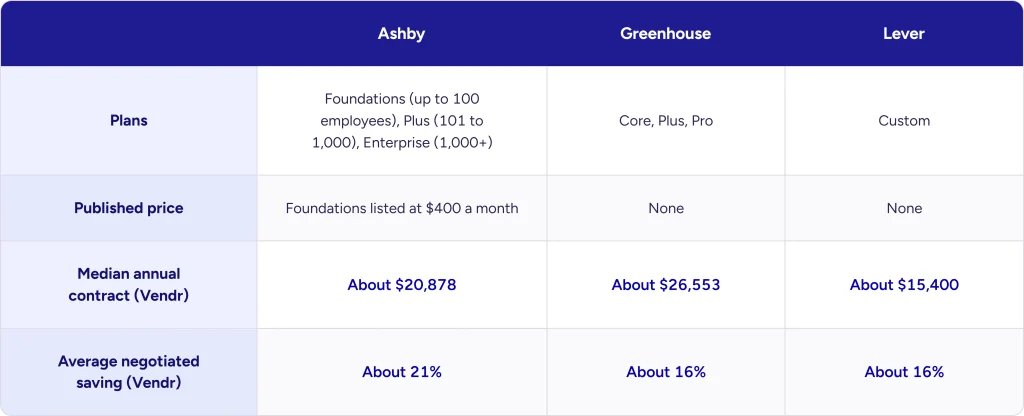
Sources: Ashby and Greenhouse pricing pages and Vendr purchase data for Ashby, Greenhouse, and Lever, checked on 23 October 2026.
Read the medians as a sense of scale, not a quote. They blend small and large customers, and each vendor’s price moves with company size, hiring volume, add-ons and contract length. The average savings figures are a reminder that first quotes from all three leave room to negotiate, especially on multi-year terms and implementation.
How each one feels to the people who use it
An ATS has four kinds of users, and each feels the product differently. Ask for demo logins for each role, not only the admin view.
Recruiters
Recruiters live in the pipeline view, sourcing tools and candidate communication. Lever’s CRM-first layout suits recruiters who source heavily. Ashby puts sourcing sequences, scheduling and reporting in the same place, which reduces switching between tools. Greenhouse gives recruiters a clear process to run, with structure already defined for each role.
Hiring managers
Hiring managers log in occasionally, so ease matters more than power. Greenhouse’s interview kits tell them exactly what to assess. In any of the three, check how quickly a manager can find a candidate’s feedback, submit a scorecard from a phone and see where their open roles stand.
Recruiting coordinators
Scheduling is where coordinators spend their week. All three offer scheduling tools, but advanced features differ by plan. On Ashby, advanced scheduling is an add-on on Plus. Test a five-person panel interview across two time zones in each product before deciding.
Talent acquisition leaders
Leaders need forecasting, capacity planning and answers for the executive team. Ashby’s recruiting planner and custom dashboards target this user directly. Greenhouse’s BI connector suits leaders who report from a central BI tool. Lever offers built-in reporting and, since February 2026, a dashboard that measures time saved through AI-supported interviews.
Which ATS fits your stage
Ashby vs Greenhouse, and where Lever fits, looks different at each company size.
Under 100 employees, one or two recruiters
Speed of setup and low admin matter most, because nobody has time to run a configuration project. Ashby’s Foundations plan is designed for this size and publishes its price, which makes budgeting simple. Lever is a common choice if sourcing is most of the job. Greenhouse Core works well here if the founders want structured hiring habits in place before the company scales.
100 to 1,000 employees, a growing recruiting team
This is where all three compete hardest and where the original problem statement matters most. Inconsistent interviews across new managers point to Greenhouse. Weak pipeline reuse across repeat roles points to Lever. Reporting built by hand every month points to Ashby. At this size, also check the limits that appear on plan pages, such as the number of brands and custom permission roles on Ashby Plus.
1,000 or more employees, several regions
Governance becomes the deciding factor: permissions, audit logs, data residency, sandbox environments and support for works councils. Greenhouse Pro and Ashby Enterprise both target this level, with audit logs, sandbox environments and SCIM user provisioning listed. Ask each vendor for a reference customer of similar size in your regions, and ask how they handle separate brands and regional data rules.
High-volume hourly hiring
None of the three was designed mainly for high-volume hourly hiring, where conversational applications, instant scheduling and text-first communication matter most. If you hire hundreds of frontline workers a month, compare them with tools built for volume, such as those in our list of the best ATS software.
Switching from your current ATS
An ATS move is mostly a data and process project, and it usually takes longer than the sales cycle suggests. Agree these points in writing before you sign:
- Which candidates, notes, attachments and scorecards will migrate, and which will be archived in read-only form
- How existing talent pools, tags and sources map to the new system
- Which integrations must be live on day one: HRIS, calendar, job boards, assessments and background checks
- Who rebuilds interview plans and scorecards for each job family, and who signs them off
- How long you keep access to the old system, and how candidate data deletion requests are handled during the move
Time the switch away from your heaviest hiring months, and run both systems in parallel for open requisitions rather than moving live candidates mid-process.
A two-week evaluation plan
- Day 1 to 2: give each vendor the same brief, built from your problem statement, three real job descriptions and your five must-have integrations.
- Day 3 to 5: run scripted demos in which each vendor builds one structured interview plan, one sourcing sequence and one report live.
- Day 6 to 9: give a recruiter, a hiring manager and a coordinator sandbox access to complete their own everyday tasks.
- Day 10 to 12: collect line-item quotes covering plan, add-ons, AI credits, implementation and support.
- Day 13 to 14: score each product against the original problem, user feedback and first-year cost, then call one reference customer for the leading option.
Two compliance checks before you sign
First, AI and fairness. If you hire in the EU, AI used to rank or screen candidates is classed as high-risk under the EU AI Act, with obligations applying from 2 December 2027. Employers will need records of how AI is used, meaningful human involvement and a way to explain outcomes. Ask each vendor how a recruiter sees why a candidate was ranked, how overrides are recorded and how long those records are kept.
Second, pay transparency. EU employers will need to give pay ranges in job ads or before interviews and stop asking about pay history, so confirm the ATS supports pay range fields on requisitions and lets you remove pay history questions from every application form. Our EU Pay Transparency Directive checklist sets out the timeline. For a closer look at one of the three, read our Greenhouse ATS review.
FAQs:
Ashby vs Greenhouse: which is better?
Ashby is stronger on built-in analytics and publishes a starting price, while Greenhouse is known for structured interviewing. The better choice depends on which problem you need to solve first.
Is Greenhouse or Lever better?
Greenhouse suits teams that want consistent, structured evaluation. Lever suits teams that rely on sourcing and re-engaging candidates through its built-in CRM.
How much does Ashby cost?
Ashby lists its Foundations plan at $400 a month for companies of up to 100 employees. Larger plans are quoted, and Vendr puts the median contract at about $20,878 a year.
How much does Greenhouse cost?
Greenhouse does not publish prices. Vendr’s purchase data puts the median contract at about $26,553 a year.
Which ATS is best for startups?
Ashby’s Foundations plan is built for companies of up to 100 employees, and Lever is also common for sourcing-heavy startup teams.
How long does it take to switch ATS?
It depends on data volume and integrations. Plan for a data migration, rebuilt interview plans and a period of running both systems for open roles.
What are good Greenhouse alternatives?
Ashby and Lever are the most common, alongside other ATS products compared in our best ATS software list.