


Most job descriptions do not describe the job. They describe a fantasy candidate: a list of requirements no single person could realistically meet, wrapped in corporate language that tells applicants nothing about what they are actually walking into.
The result is predictable. Strong candidates scroll past because the role sounds either daunting or vague. Average candidates apply anyway. Your recruiter spends two weeks filtering through the wrong people and wonders why the pipeline looks thin.
Your job description is your first piece of employer marketing. Get it right, and it qualifies candidates in and out before your team speaks to a single person. This guide covers exactly how to write a job description that does that job well, from the structure and language to the five-minute check before you post.
| How to write a job description: Start with the title candidates actually search for. Write an honest 2-3 sentence opening. Describe real day-to-day work. Separate must-haves from nice-to-haves. List specific benefits, including a salary range. Avoid jargon, overloaded requirements, and vague phrases like ‘fast-paced environment.’ |
Why Most Job Descriptions Fail Before Anyone Reads Them
Before we get into how to write a job description that works, it helps to see exactly where most of them break down. These are the job description mistakes that appear most often, and they are all avoidable:
- Requirements inflation. A study published in Harvard Business Review on hidden workers found that employers routinely require qualifications beyond what the role genuinely needs. Candidates, particularly women, frequently self-screen out of positions they are qualified for when the requirements list reads like a wish list rather than a minimum bar.
- No real information about the work. A list of responsibilities that could describe any company in any industry tells candidates nothing about what they will actually spend their time on or why it matters.
- No salary. LinkedIn Talent Insights data consistently shows salary-inclusive postings receive more applications and receive them faster. Omitting compensation is no longer neutral: candidates assume the worst and move on.
- Jargon that signals culture narrowly. Phrases like ‘rockstar,’ ‘hustle culture,’ and ‘fast-paced environment’ are not neutral descriptors. They signal to a specific type of candidate while actively putting off others.
- Copy-pasted from the last hire. Job descriptions written around a specific past employee carry that person’s background and biases into the next search. The role may have changed significantly. The description often has not.
The 7 Parts of a High-Performing Job Description
Here’s how to write a job description in seven parts, each doing a specific job in a candidate’s decision to apply.
[In-body diagram: job-description-anatomy-diagram.png – insert here. See the visual brief above.]
1. Job Title
| Write the title candidates actually search for, not your internal grade or a quirky rebrand. ‘Marketing Manager’ outperforms ‘Growth Wizard’ every time. Keep it under 60 characters, match what your target hire would type into LinkedIn or Google, and avoid inflating seniority in the title to make the role sound bigger than it is. |
2. The Opening Paragraph
| Two to three sentences answering the only question candidates have at this point: why would I want this job? Not a company history. Not a list of awards. A direct, honest statement about what the role does and why it matters. This is the section most hiring managers spend the least time on. It is the one candidate who reads most carefully. |
3. What You’ll Be Doing
| The most-read section. Use plain bullet points, six to eight of them, each starting with a verb. Describe the actual work the person will do most of the time, not aspirational tasks that come up twice a year. If candidates cannot picture their Tuesday afternoon from reading this section, it needs rewriting. |
4. What We’re Looking For
| Separate must-haves from nice-to-haves. Must-haves are the genuine minimum for day-one performance. Five or six items, no more. Nice-to-haves are real bonuses, not requirements in disguise. Aim for three or four. This is the section most responsible for filtering out good candidates who assume they need to tick every box to be considered. |
[In-body image: job-description-requirements-before-after.png—insert here after Step 4. See the visual brief above.
5. What We Offer
| Include a salary range. List benefits specifically: four weeks of paid leave, a remote-first policy, a monthly learning budget, and stock options. Do not write ‘competitive compensation and benefits package. ‘Candidates know what that means. Specifics signal honesty; vagueness signals the opposite. |
6. About the Company
| Three to four sentences. What the company does, who it serves, and why the work matters. Avoid superlatives. ‘We are a leading provider of…’ tells candidates nothing. We build compliance software used by 3,000 financial services firms’. |
7. How to Apply
| Tell candidates exactly what to submit and what happens next. If there is a screening question, work sample, or assessment, say so now. Candidates who discover additional steps after applying feel misled. Include an approximate timeline so people know whether to expect a call in a week or a month. |
Words That Exclude vs. Words That Welcome
Language audits on job postings consistently show that certain words and phrases reduce a qualified candidate’s potential by making roles feel narrow or unwelcoming, without improving the candidate pool. These are the most common offenders:
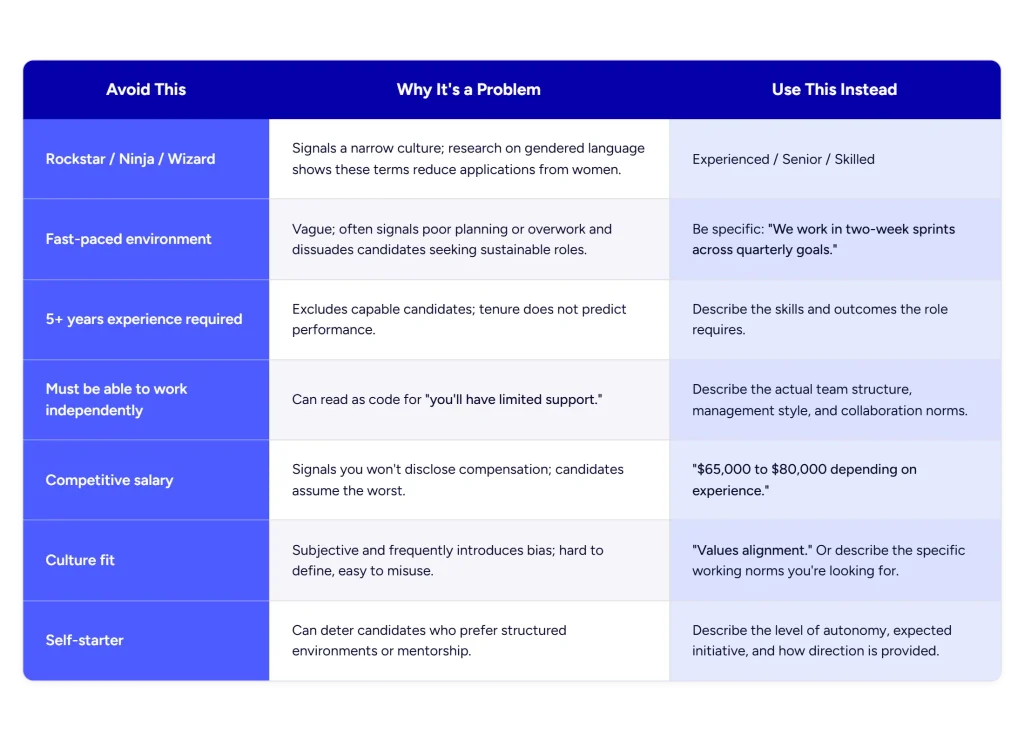
Writing inclusive job descriptions is not about softening requirements. It is about ensuring the language used reflects the actual role rather than the background of whoever held it last. Tools like Textio can run an automated audit before posting, flagging terms statistically associated with lower application rates from specific groups.
The 5-Minute Check Before You Post
Knowing how to write a job description well doesn’t require a long review process. Five questions, run through honestly, catch most issues:
- Is the job title what candidates actually search for? Run it through LinkedIn Jobs or your ATS search to see what volume looks like.
- Would a strong candidate from a different company understand what this job actually involves? If not, add specifics.
- Does every must-have requirement reflect the genuine minimum for day-one performance? Remove or demote anything that does not.
- Is salary included? If not, add it. If there is a reason not to, document it internally and revisit at the next hiring cycle.
- Read the opening paragraph out loud. Does it sound like a person wrote it or like a committee approved it? Rewrite until it sounds like the former.
Job Description Template
This template shows how to write a job description using the seven-section structure above—copy it, fill in the sections, and delete the guidance notes before posting.
| [Job Title] About this role 2-3 sentences: what the role does, who it serves, and why it matters. Direct and honest. What you’ll be doing 6-8 bullets starting with a verb. Real work, not aspirational tasks. What we’re looking for Must-haves (5-6): the genuine minimum for day-one performance. Nice-to-haves (3-4): genuine bonuses, clearly labeled as such. What we offer Salary: $X,000 to $Y,000 depending on experience. Benefits: List 3-5 specifically, not generically. About [Company Name] 3-4 sentences. What you do, who you serve, and why it matters. No superlatives. How to apply What to submit. Any assessments or screening steps. Approximate timeline. |
Your Job Description Is Your First Hiring Decision
Knowing how to write a job description well is not a skill most hiring managers receive formal training on. The gap shows up in inboxes full of mismatched applicants and sourcing spend trying to compensate for a description that was never doing its job.
A clear, honest, well-structured posting is one of the fastest improvements a talent acquisition team can make. It costs nothing beyond the time required to think precisely about what the role actually involves and who could genuinely do it.
Once the right candidates start applying, you’ll need a system to track and manage them efficiently. Our guide to the best ATS software in 2026 covers the platforms that handle structured hiring best, or read the Greenhouse ATS review if you’re evaluating that platform specifically. Ready to turn better job descriptions into a stronger hiring pipeline? Our recruitment marketing team builds job postings and employer branding that get the right candidates applying.
FAQs:
How long should a job description be?
Aim for 300 to 600 words, long enough for candidates to judge if they’re a fit but short enough that they’ll actually finish reading it, since drop-off rises sharply past 700 words and every sentence should earn its place by helping someone decide whether to apply.
Should I include salary in a job description?
Yes. Postings that include salary attract more applicants and attract them faster; several US states now require pay transparency by law, and leaving compensation out signals candidates will have to negotiate blindly, which erodes trust before the first conversation even happens.
How many requirements should I list?
Stick to five or six must-haves and three or four nice-to-haves, since lists beyond eight items reduce applications without improving candidate quality, and if someone could succeed in the role on day one without an item, it isn’t a genuine requirement.
How do I write an inclusive job description?
Audit the language with a tool like Textio or the avoid list above, separate required from preferred qualifications, swap years-of-experience thresholds for skill and outcome descriptions, and state your equal opportunity policy and accessibility provisions explicitly rather than leaving candidates to ask.
How often should job descriptions be updated?
Every time you reopen a role, since a position that’s evolved needs fresh language rather than a copy of the last version, as responsibilities, salary bands, and team structures shift over 12 to 18 months.