

The Workable vs. Greenhouse decision comes up in almost every mid-market ATS evaluation, and it frustrates people because both platforms review well, both have strong G2 ratings, and both handle the core recruiting workflow competently. The comparison articles that say ‘it depends’ are right but unhelpfully so. It depends on something specific: how much of your company’s hiring consistency relies on the ATS enforcing the process rather than people following it voluntarily.
That one variable—enforcement versus suggestion—explains nearly every meaningful difference between these two platforms. This comparison starts with the verdicts by stage, then works through the evidence.
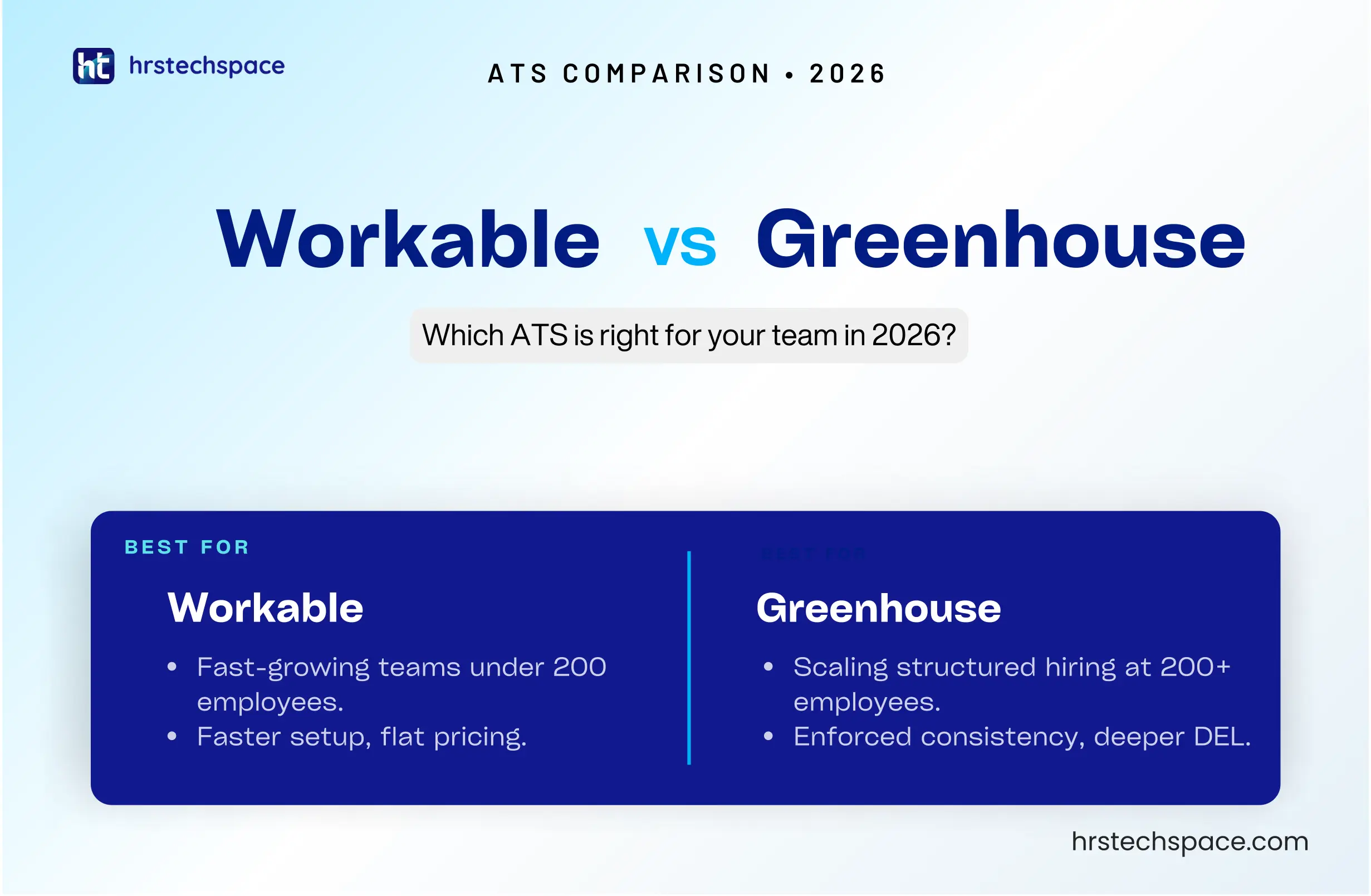
| Under 200 employees, under 30 hires/year: Workable. Faster to implement, simpler pricing, capable enough for this volume. The structured hiring enforcement Greenhouse provides a process overhead you probably do not need yet. 200-500 employees, 30-100 hires/year: Evaluate both. Workable handles the volume. Greenhouse starts earning back its complexity when you have multiple hiring managers running simultaneous searches and DEI reporting is a strategic priority. 500+ employees or enterprise: Greenhouse. The process enforcement, DEI analytics depth, and integration ecosystem have no credible match from Workable at this scale. |
Workable vs. Greenhouse: Side-by-Side in 2026
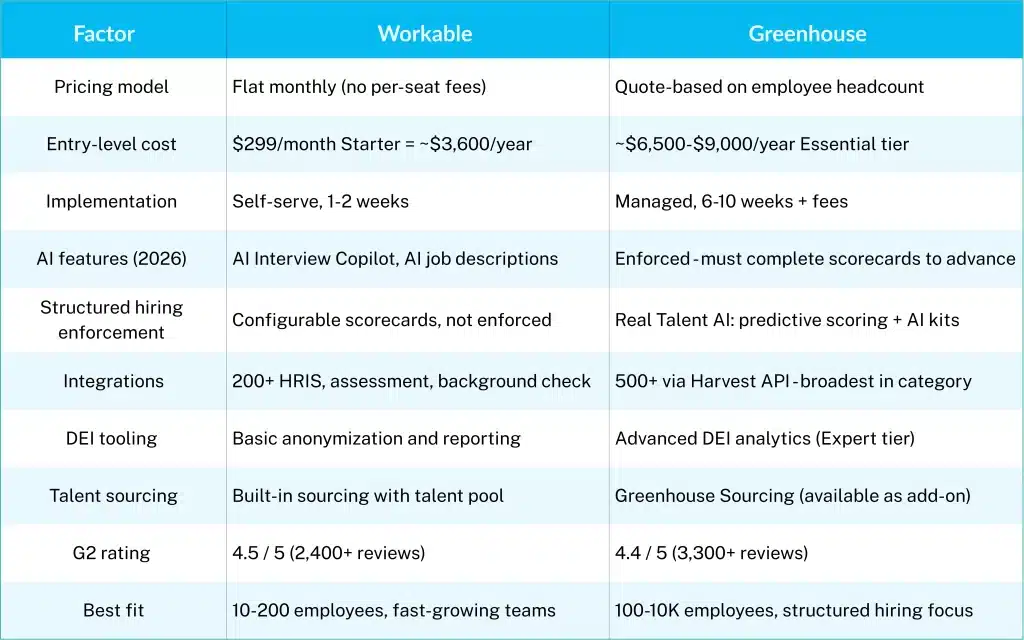
Pricing verified April 2026. Greenhouse figures are buyer-reported ranges from procurement and contract reviews.
Pricing: Workable vs. Greenhouse Pricing Comparison
Workable publishes its pricing. Greenhouse does not. Those alone shape procurement timelines—every Greenhouse evaluation begins with a sales conversation before you can do basic budget qualification.
Workable pricing:
- Starter: $299/month billed annually ($3,588/year). Up to 2 active jobs.
- Growth: $449/month ($5,388/year). Unlimited active jobs, full analytics, branded careers page.
- Business: $749/month ($8,988/year). Custom roles, advanced automation, priority support.
No per-seat fees as the team grows. A company with 5 recruiters and one with 20 recruiters pay the same subscription on the same plan.
Greenhouse pricing reality (buyer-reported, April 2026):
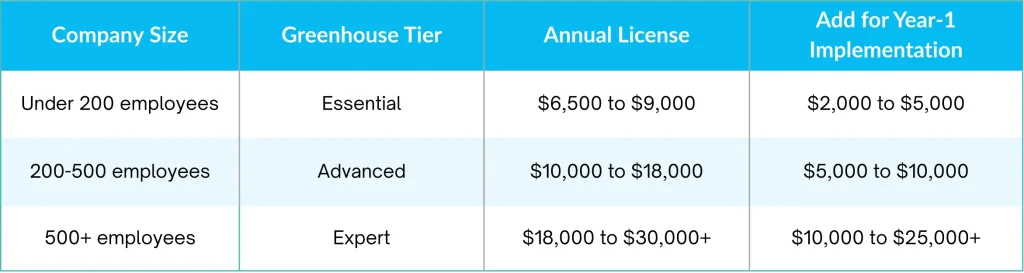
For a 100-employee company making 25 hires per year: Workable Growth runs $5,388 annually. Greenhouse Advanced typically runs $10,000 to $14,000 in licenses plus $5,000 to $8,000 in implementation year 1. The total Year-1 difference is roughly $10,000 to $17,000. That is a meaningful budget for a mid-market HR team. While these estimates reflect typical buyer-reported costs, official pricing may vary based on company size, hiring volume, and selected features.
The more important question is whether the additional cost changes hiring outcomes. For teams under 200 employees and under 30 hires per year, the honest answer is usually no. For teams running 50+ concurrent searches with multiple hiring managers, the answer starts shifting.
Implementation: Weeks vs Months, and Why It Matters
Another important part of the Workable vs. Greenhouse decision is implementation time and onboarding effort. Workable is built to be self-serve. Most teams are posting jobs and reviewing candidates within a week of signing up.
No dedicated implementation support required. An HR generalist with no prior ATS administration experience can configure and run it. Verified user reviews frequently mention implementation speed as one of Workable’s biggest advantages for growing teams.
Greenhouse is built to be implemented. The configuration is substantially more involved: scorecard templates, interview kit structures, approval workflows, permission hierarchies, integration pipelines, and onboarding the hiring manager population. Done properly, this takes 6 to 10 weeks. Attempting to rush it produces a greenhouse installation that looks structured but does not function as one.
That gap matters in two directions. For a company that needs to start hiring in three weeks, Workable is the only reasonable answer. For a company willing to invest 10 weeks configuring a system correctly before trusting it at scale, Greenhouse’s upfront investment produces something Workable cannot replicate a self-auditing hiring process that does not rely on individual discipline to stay consistent.
Workable vs. Greenhouse AI Features: Two Different Philosophies
Workable AI Interview Copilot
Workable’s AI Interview Copilot transcribes video interviews (with candidate consent) and generates structured notes mapped to scorecard criteria. Recruiters consistently report reduced post-interview admin time. The feature turns on without configuration, delivers value immediately, and is available across tiers. The design philosophy is straightforward: make the recruiter faster at the tasks they already do.
Greenhouse Real Talent AI
Greenhouse’s Real Talent AI takes a different approach. Rather than speeding up the recruiter’s existing process, it learns from structured hiring history. It analyzes patterns in completed scorecards, interview feedback, and historical hire outcomes to generate predictive candidate scores. The quality of those predictions is directly proportional to the quality and volume of structured data accumulated in the system.
For a company in its first year on Greenhouse, Real Talent AI is still learning. For a company with two or three years of disciplined structured data, it starts surfacing insights that a recruiter’s gut feeling cannot match. The design philosophy: use the discipline you have already built to make better predictions over time.
Neither approach is universally better. If the primary problem is recruiter efficiency today, Workable’s AI is immediately useful. If the primary problem is hiring quality at scale over time, Greenhouse’s AI compounds in value.
Structured Hiring: The Core Difference
The biggest difference in Workable vs. Greenhouse is how each platform handles structured hiring and interview consistency. Only Greenhouse enforces it.
In Greenhouse, a hiring manager cannot advance a candidate without every interviewer completing their scorecard. Evaluation criteria are identical for every candidate in every role. The platform makes gut-feel advancement operationally difficult and makes consistency auditable.
In Workable, scorecards and evaluation criteria exist and work well. But they can be configured as optional. An interviewer who skips or forgets a scorecard faces no system friction. At ten hires per year with a close-knit team genuinely committed to structured hiring, this is a non-issue. At fifty concurrent searches across thirty hiring managers with varying levels of process commitment, it becomes the most important variable in hiring quality and equity. If consistent, auditable, bias-reduced hiring is a strategic priority—not just a value statement—Greenhouse earns its price. If it is a preference but not a hard requirement, Workable’s more flexible approach is sufficient and significantly cheaper.
The Decision by Stage
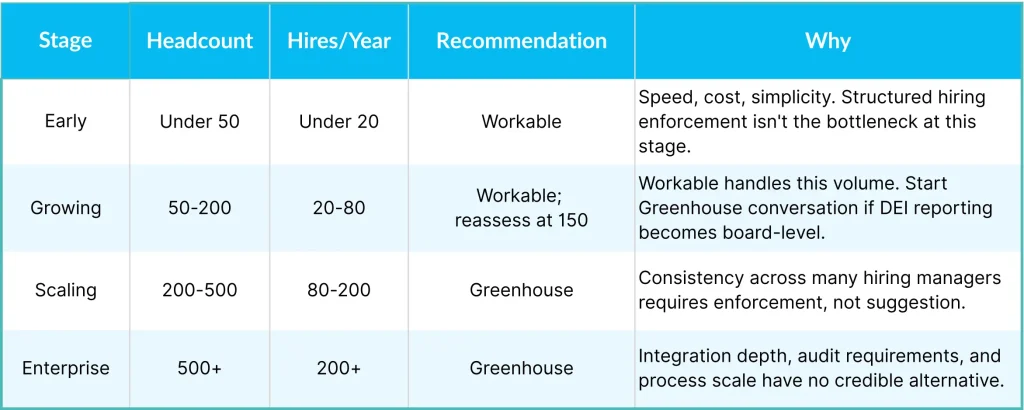
The Bottom Line
The Workable vs. Greenhouse comparison resolves differently depending on whether you need a great ATS today or a structured hiring system that scales for the next five years.
Workable is a better product for most companies under 200 employees. Cheaper, faster, and capable enough for the hiring complexity those organizations face. That is not faint praise—capable, fast, and affordable is exactly what most early-growth companies need from their ATS.
Greenhouse is a better investment for companies that have reached the stage where hiring consistency across many simultaneous searches is the bottleneck. That stage is typically 200+ employees with 30+ hires per year and leadership that treats structured hiring as a strategic rather than operational priority. At that point, Greenhouse’s enforcement, DEI depth, and Real Talent AI compound into something Workable cannot replicate. For the full ATS market view, see our roundup of the best ATS software in 2026.
FAQs:
Workable vs. Greenhouse: Which is better for a startup?
For startups under 100 employees with fewer than 30 hires a year, Workable vs. Greenhouse usually favors Workable due to its lower cost, faster setup, and sufficient hiring features. Greenhouse becomes more valuable as hiring volume and process complexity grow.
What does Greenhouse actually cost for a 200-person company?
A 200-person company typically pays $18,000–$26,000 in the first year, including licensing and implementation. Renewal costs vary, so negotiating pricing terms upfront is recommended.
Can Workable handle enterprise-scale hiring?
Workable supports businesses up to around 500 employees and 200+ annual hires, but Greenhouse is generally the better choice for enterprises needing advanced workflows, integrations, and detailed hiring analytics.
Is Greenhouse Real Talent AI actually useful?
Yes, but its value increases over time. Teams with 12+ months of structured hiring data benefit the most, while newer users may see more limited predictive insights.
Which ATS is fastest to go live?
Workable. Most teams are posting jobs within a week. Greenhouse requires 6 to 10 weeks of proper configuration. Lever and Ashby sit between the two. If time-to-live is the primary constraint, Workable is the clear answer.