

The majority of Greenhouse ATS Review 2026 content you’ll encounter was likely written by someone who visited a demo account for half an hour, explored a virtual “sandbox” environment, and regurgitated the same marketing buzzwords.
This isn’t your typical ATS breakdown.
I’ve seen Greenhouse from the inside, not just during polished sales demos, but during messy hiring cycles, recruiter burnout, interview chaos, ATS migration projects, and executive reporting meetings where everyone suddenly realizes the ATS matters more than they thought.
Over the years, I’ve sat through Greenhouse ATS demos at three different companies. I’ve helped teams migrate to it twice and migrate away from it once. I’ve watched recruiters genuinely enjoy using parts of it, while also building spreadsheets, Slack workflows, and manual workarounds for the parts that slow them down.
And after reviewing more than 200 Greenhouse ATS implementations across startups, mid-sized companies, and enterprise recruiting teams, I have a pretty clear sense of where Greenhouse fits in 2026 and where it absolutely does not.
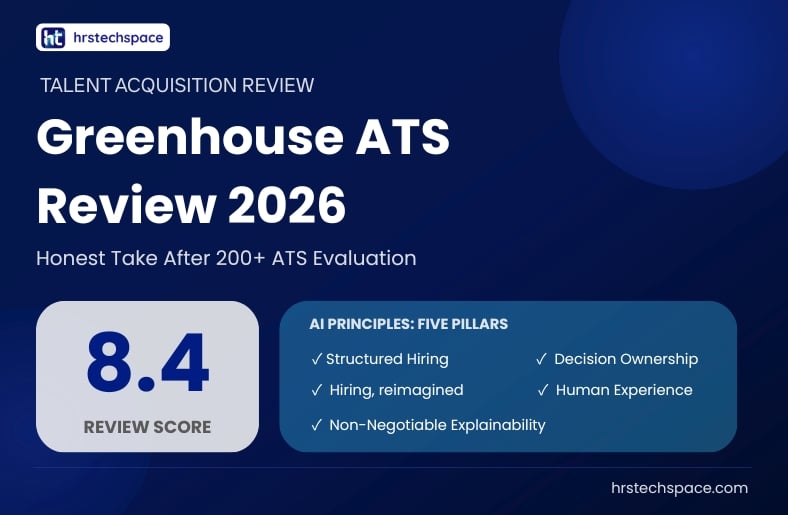
Greenhouse ATS Review: 30-Second Verdict
Score: 8.5 / 10
Best for: Mid-market & enterprise companies (structured hiring, recruiting ops support, high hiring volume)
Real Year-1 Cost: Subscription + setup + integrations + training + operational overhead — 1.5x to 3x the headline subscription price
Skip if you have a small team without recruiting ops support, need simpler/cheaper setup, want strong AI-native features, or need predictable pricing
What You Actually Get with Greenhouse’s Recruiting Software
What sets Greenhouse apart from other applicant tracking systems is its strong focus on structured hiring. Everyone involved in hiring follows the same structured hiring process. Interviewers use standardized scorecards, candidates are judged against the same criteria, and feedback is collected in a consistent format. That can feel a little rigid, but it helps companies make more organized and fair recruitment decisions, especially as teams grow.
In my experience, companies that fully use Greenhouse usually hire faster, reduce recruiting inefficiencies, and improve collaboration between recruiters and hiring teams.
Greenhouse itself is split into three main parts: the core applicant tracking system for managing candidates and interviews, Greenhouse Sourcing for building relationships with passive candidates, and Greenhouse Onboarding for handling the transition from offer letter to employee onboarding.
It also connects with 500+ other recruiting and HR software tools, which is one of the reasons larger companies often prefer it.
Greenhouse Pricing in 2026: What It Really Costs
Greenhouse does not publish pricing. They use a quote-based model based on your total employee count, which means every conversation starts with a sales cycle.
After reviewing multiple Greenhouse contracts and procurement cycles, here’s what Greenhouse ATS cost in 2026 typically looks like in 2026:
- Essential/Core Tier: Roughly $6,500–$9,000 per year for smaller companies with basic hiring needs.
- Advanced Tier: Around $10,000–$18,000 per year for growing companies that need candidate sourcing tools, reporting, and more advanced workflows.
- Expert Tier: Usually starts around $18,000–$25,000+ for larger organizations that want enterprise reporting, DEI features, and deeper customization.
But the biggest mistake companies make is assuming the license fee is the total cost.
It’s not.
Once implementation, integrations, onboarding, and internal admin time are included, the real total cost can end up being 1.5x to 3x higher than the original quote.
For example, for a 500-person company, the pricing can look reasonable at first glance. The Advanced plan might be quoted at around $14,000 per year. But that’s usually just the starting point.
Once you add:
- $5,000 for implementation,
- $2,500 for a custom integration,
- and the internal time spent by HR and recruiting teams during setup (often worth around $25,000 in employee time),
The real first-year cost becomes closer to $46,500. That doesn’t mean Greenhouse isn’t worth the investment. For many growing companies, it absolutely is. The platform can improve hiring processes, save recruiter time, and bring much more structure to recruiting. But the key is to budget based on the real operational cost, not just the attractive number shown during the sales process.
Where Greenhouse’s Hiring Platform Genuinely Excels
Greenhouse continues to rank among the highest-rated recruiting platforms across review and analyst platforms like G2, Gartner, Fosway, and IDC, and after working with it across multiple companies, it’s not hard to see why.
The biggest reason is its approach to structured hiring software. Most platforms let companies build structured hiring workflows, but Greenhouse is one of the few that actually enforces them. Interviewers are required to complete scorecards and structured interview feedback before moving candidates forward.
Another area where Greenhouse ATS has improved significantly is AI. Its AI system, Real Talent AI, expanded heavily through 2025 and 2026 and is one of the more useful AI talent acquisition features currently available in an ATS. Instead of relying only on keyword matching, it analyses structured hiring data like scorecards, interview feedback, and patterns from successful hires to help identify stronger candidates.
Greenhouse also stands out for its DEI tracking and recruiting analytics capabilities, especially on higher-tier plans. Companies can track demographic data throughout the hiring funnel, anonymize resume reviews, identify where candidates drop out of the process, and even flag potentially biased language in interviewer feedback.
Its large integration ecosystem and updated recruiting analytics and reporting tools are also strong advantages, although at this price point, those features are increasingly expected rather than unique.
Common Frustrations with Greenhouse’s Recruitment Platform
Even though Greenhouse is one of the strongest ATS platforms on the market, a few complaints come up repeatedly from recruiters and hiring teams.
The biggest one in 2026 is AI innovation speed. Many longtime Greenhouse customers feel that in the Greenhouse vs. Ashby comparison, many feel Ashby is moving faster on new AI features and automation. Greenhouse tends to release features more carefully and slowly, focusing on stability and accuracy rather than rapid experimentation.
Another common frustration is candidate search and talent rediscovery. Searching old applicants inside Greenhouse can still feel clunky and limited, especially for recruiters trying to rediscover past candidates. As a result, many recruiters end up going back to LinkedIn instead of using Greenhouse’s internal talent database, even though they’re already paying for those features.
The third issue is pricing transparency. Greenhouse still doesn’t publish clear pricing publicly, so companies have to go through a sales process just to understand costs. For many procurement and HR teams, that makes budgeting slower and more complicated than it needs to be.
What Implementing Greenhouse Actually Feels Like
Rolling out Greenhouse isn’t merely a software installation project; it is typically an entire recruiting operation and transformation of the recruiting process. Greenhouse’s structured hiring platform is one of the most enterprise platforms, but its implementation is dependent on process alignment, recruiter adoption, workflow setup, and long-term management of recruiting operations.
Here’s what companies should realistically expect during a Greenhouse applicant tracking system implementation:
- Stakeholder buy-in must be ensured
Before implementing Greenhouse ATS, recruiters, hiring managers, HR leaders, and executives should agree on hiring workflows, interview stages, scorecards, and hiring approval. - The time required for training your recruiters will be considerable.
When teams switch from a spreadsheet, manual hiring process, or older ATS, retraining on a structured hiring process, interview workflow, and candidate evaluation standards may be necessary. - The rate of hiring manager adoption can be a key factor in slowing rollout.
Getting hiring managers to consistently use structured scorecards and submit interview feedback is one of the biggest rollout challenges. - Structured scorecards are the key to the success of an Applicant Tracking System (ATS)
The best results are obtained when the interviewer completes standardized score cards and feedback forms in the same manner each time. This directly impacts recruiting analytics and reporting accuracy, recruiting analytics, and AI recommendations. - ATS migration projects are typically unappealing.
When you switch from another ATS, you typically have duplicate candidates, mismatched stages in the pipeline, broken workflows, and incomplete hiring data. - Data cleanup is a major part of implementation
There is often a lot of data to clean, workflows to standardize, and records to organize before migration can take place. Many businesses spend weeks preparing their data, streamlining their processes and organizing the candidate records before migration can occur. - HR and recruiting integrations require setup time
It’s not as easy as it sounds to integrate Greenhouse with HRIS systems, calendar tools, sourcing platforms, assessments, employee onboarding tools, or talent acquisition analytics tools, and talent acquisition analytics tools often take longer than expected. - Talent acquisition operations (TA Ops) ownership is critical for long-term success
It’s rare for a good Greenhouse ATS deployment to be owned by nobody or left in the hands of someone who does not have a dedicated TA Ops owner.
Pros and Cons of Greenhouse
| Component | Pros | Cons |
| Structured Hiring | Excellent interview scorecards and standardized hiring workflows improve consistency | Can feel too rigid for smaller or fast-moving teams |
| Reporting & Analytics | Strong hiring reports, pipeline tracking, and recruiting analytics insights | Takes time to learn and often needs TA Ops support |
| AI Features | Real Talent AI provides useful hiring insights based on structured data | AI innovation is slower compared to competitors like Ashby |
| Integrations | Connects with 500+ HR and recruiting tools | Custom integrations can become expensive |
| Pricing & Implementation | Powerful platform for scaling companies with complex hiring needs | Real first-year costs are usually much higher than the initial quote |
Greenhouse vs. the Best ATS Alternatives in 2026
For most teams evaluating Greenhouse in 2026, the best ATS alternatives for 2026 are Ashby, Workable, and Lever. Here’s the ATS comparison.
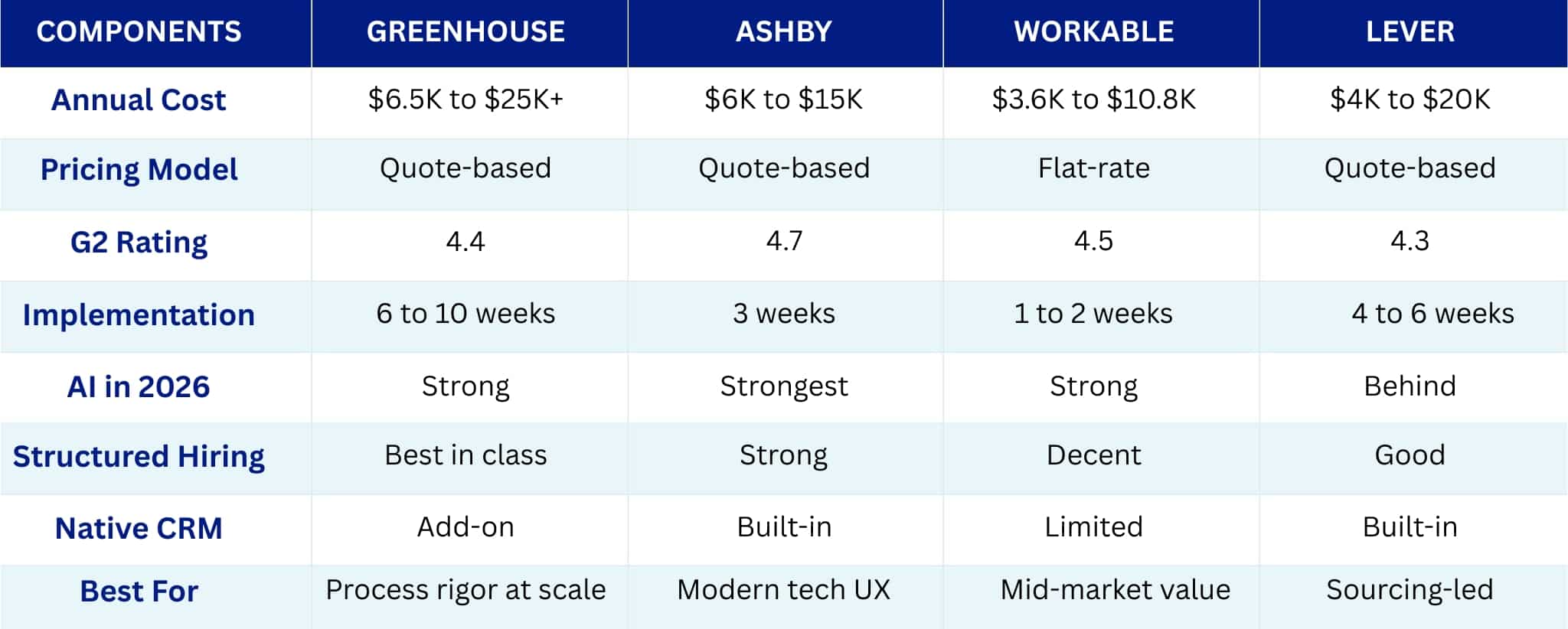
Ashby has become the platform tech-forward growth-stage companies (50 to 500 employees) default to in 2026, making the Greenhouse vs. Ashby decision one of the most common evaluations teams run. In a Greenhouse vs. Workable comparison, Workable wins for teams that want flat-rate pricing transparency. In a greenhouse vs. lever matchup, lever wins if your motion is sourcing-heavy passive candidate outreach.
Who Should Buy Greenhouse?
While Greenhouse is a great ATS pick for enterprise teams, it’s not for every company.
Consider using a greenhouse if:
- You recruit in excess of 30 employees each year
- Consistency of the hiring process is a serious issue
- You wish to have a more structured and scalable hiring process.
- Reporting and recruiting on diversity, equity, and inclusion is a strategic priority.
- Your organization has 100 to 10,000 people in it. Deep integrations with HR, sourcing, onboarding, and recruiting software tools are required.
- You have internal talent acquisition operations or TA Ops support
- Your leadership team has a commitment to implementation and process improvements over time
- You’d rather invest in a mature, stable ATS platform than chase fast-moving but unproven AI features.
What Real Customers Say About Greenhouse
I pulled a sample of about 100 reviews across G2, Capterra, and Software Reviews in April 2026 to see how Greenhouse ATS holds up in real-world use. Here’s the pattern.
The structured hiring methodology, scorecard enforcement, integration ecosystem, customer support quality, DEI tooling depth, and reporting capabilities are praised consistently across reviewer types (recruiters, TA leaders, hiring managers).
The most common critiques: AI feature pace lags Ashby and others. Talent pool search is clunky. UI feels dated in places. Pricing opacity is frustrating. The admin learning curve is real.
A representative positive quote from a TA leader at a 1,000-employee SaaS company: “Greenhouse forced us to be intentional about hiring. Structured scorecards eliminated the gut-feel decisions that were introducing bias into our process.”
A representative critique from a mid-market recruiter: “It sometimes lags on features. There are core things in the ATS that are hard to navigate or you have to find workarounds for.”
Both are true. Greenhouse ATS is intentional, mature, and a little slow.
Final Verdict: Is Greenhouse Worth It?
This Greenhouse ATS review concludes that Greenhouse remains one of the most mature and rigorous applicant tracking systems for mid-market and enterprise teams that take structured hiring seriously. The platform earns its enterprise ATS investment for the right buyers.
The hard part is being honest about whether you’re the right buyer.
If you’re 50 to 200 employees and want flat pricing with fast time-to-value, Workable will get you 80 percent of the value at 60 percent of the cost. If you’re tech-forward and care about UI and AI velocity, Ashby is now genuinely competitive. If your motion is candidate sourcing workflows, Lever’s recruitment CRM is a better fit.
For everyone else (mid-market and enterprise teams committed to scaling a structured hiring process with the budget and ops capacity to do it right), Greenhouse remains the right answer in 2026.
Just budget for what it actually costs, not what the first quote says.
Score: 8.5 / 10 Buy if your hiring volume justifies it. Skip if you want simpler.
FAQs:
How much does Greenhouse cost in 2026?
Licenses run roughly $6,500 (essential) to $25,000+ (expert) per year. Real Year-1 cost including implementation, custom integrations, and admin time typically runs 1.5 to 3 times the license fee.
Is Greenhouse worth the price compared to Ashby?
For structured hiring depth and DEI tooling, yes. For modern recruiting software interface and aggressive AI features, Ashby has caught up and, in some areas, surpassed Greenhouse. If you’re under 200 employees and tech-forward, evaluate Ashby seriously. If you’re 500+ and process rigor matters, Greenhouse is still your answer.
Does Greenhouse have native AI in 2026?
Real Talent AI for predictive scoring, AI-generated job descriptions, AI interview kit suggestions, and AI candidate summaries. The deepest analytics live on the Advanced and Expert tiers.
How long does implementation take?
6 to 10 weeks for a standard mid-market deployment. Enterprise rollouts with complex approval chains and multi-region requirements run 12 to 16 weeks. Add $2,000 to $10,000+ in Greenhouse implementation costs on top of the license fee.
Can Greenhouse handle high-volume hiring (1,000+ hires/year)?
It can, but it’s not optimized for it. iCIMS, Workday Recruiting, and SmartRecruiters are stronger above 1,000 annual hires. The greenhouse handles 500+ comfortably.
Does it integrate with Workday HCM?
Yes, natively. The integration is mature and bidirectional. Most large enterprises run Greenhouse for recruiting and Workday for everything post-hire.
What renewal increases should we expect?
8 to 15% per year is the consistent buyer report. Negotiate multi-year contracts with capped renewals or you’ll lose the budget conversation in Year 2.