
Most pay equity software was built for one job: a privileged, statistical audit of pay gaps, usually run once a year for a US employer. The EU Pay Transparency Directive asks for more than that. Employers need to answer individual worker requests, publish gender pay gap indicators, make pay criteria available, and, where a gap of 5% or more is not explained or fixed, run a joint pay assessment.
Syndio is one of the best-known names in pay equity analysis, and it has added features aimed squarely at the Directive. This Syndio review looks at what the product does today, maps each feature to the Directive’s articles, and sets out what an HR or reward team should verify before signing.
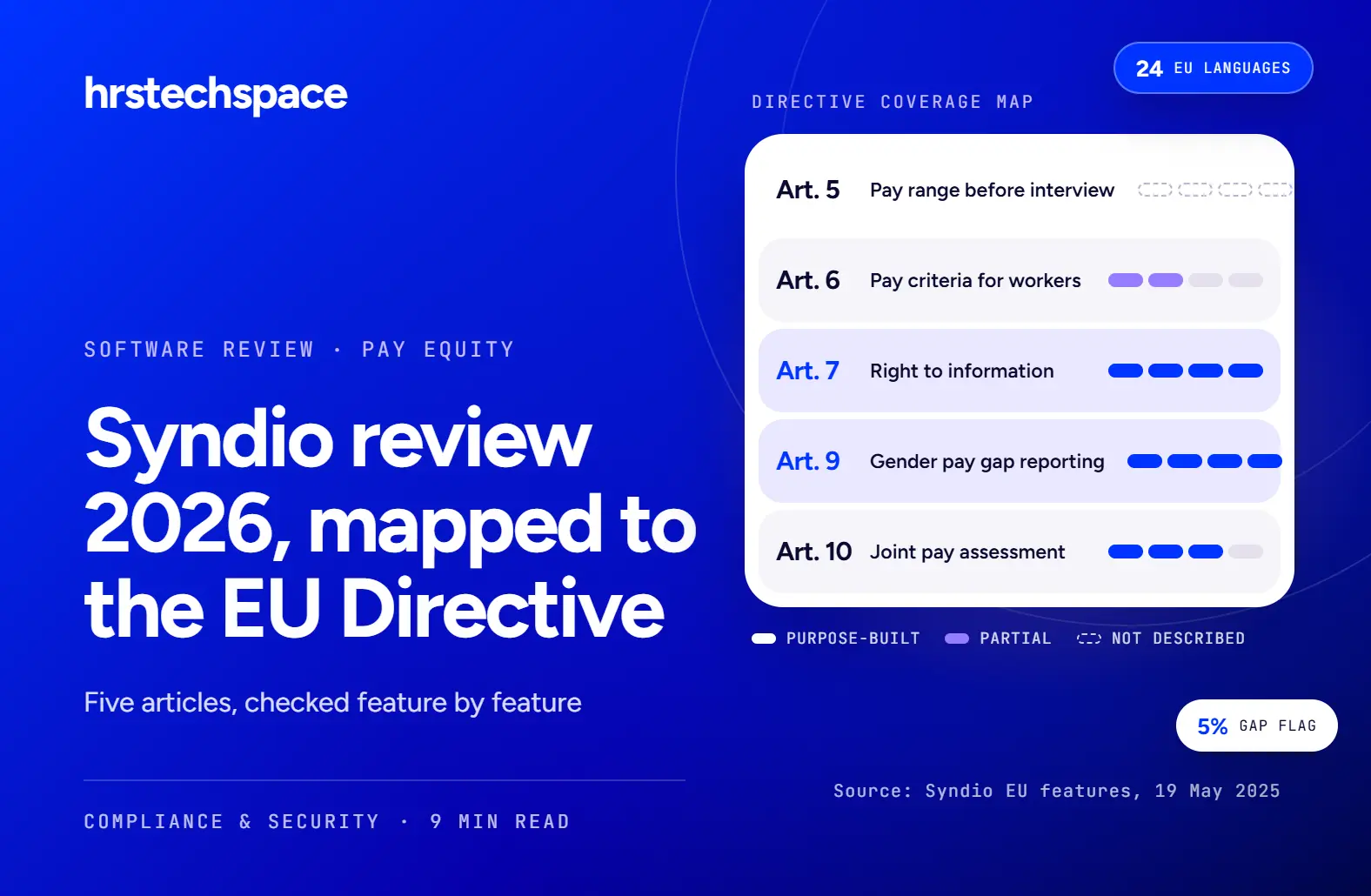
| Quick verdict: Syndio is a strong choice for large employers that want rigorous, defensible pay equity analysis and a guided path to EU Pay Transparency Directive reporting. Its PayEQ product identifies gaps of 5% or more and builds remediation budgets, and its EU features produce right-to-information reports in all 24 official EU languages. Pricing is not published. Before buying, check how it handles worker categories, salary range publication, and the joint pay assessment workflow, which its EU page does not describe in detail. |
What Syndio is
Syndio is a pay equity and compensation analytics platform that started in the United States, where large employers run regular pay equity audits to manage legal risk. Its EU Pay Transparency Directive page names enterprise customers such as Nokia, Salesforce, Siemens, and Udemy and says many Fortune and FTSE 100 companies use it.
The product line, as Syndio describes it:
- PayEQ: pay equity analysis that finds gaps, including gaps of 5% or more, and builds targeted remediation budgets
- Syndi: an AI recommendation engine intended to keep new pay decisions consistent so new gaps do not appear
- Global Pay Reports and Expertise On Demand: support for EU reporting, combining software with Syndio specialists
- Pay policies heatmap: shows which factors, such as performance, tenure, and location, actually drive pay
- Compensation Consistency Analytics
- Platform tiers named Overview, Essentials, and Decisions, with a data hub and integrations
How Syndio maps to the EU Pay Transparency Directive
Syndio announced its EU features on 19 May 2025. The table below maps them to the Directive’s main articles and notes what to confirm in a demo.
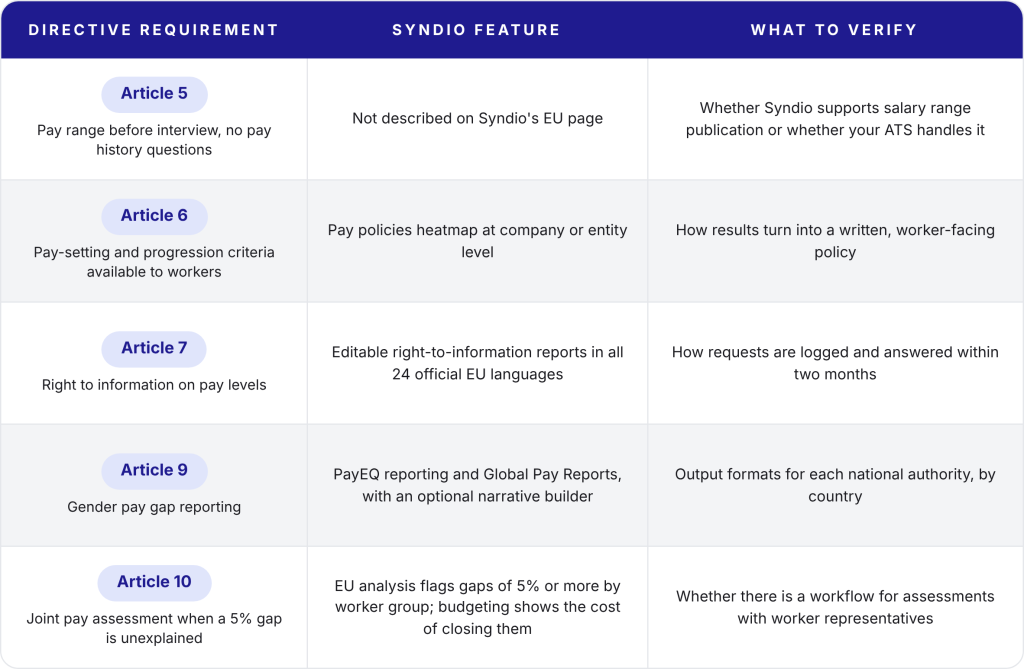
The strongest parts of the mapping are Articles 7 and 9, where Syndio has purpose-built outputs, and the gap analysis and budgeting that support Article 10. The weakest documented part is Article 5, which in most companies sits in the applicant tracking system rather than in pay equity software.
What Syndio does well
Defensible analysis
Syndio’s PayEQ runs both unadjusted and regression analyses, according to its May 2025 announcement. That matters under the Directive: an unadjusted gap tells you what to report, while a regression shows which differences are explained by legitimate, gender-neutral factors. When a gap crosses 5%, that explanation is what decides whether you need a joint pay assessment.
Remediation budgeting
Finding a gap is only half the job. Syndio’s budgeting feature shows which employees need adjustments and what closing the gaps would cost, with one-click recommendations. Reward teams can take a number to finance rather than a list of problems.
Multilingual worker reports
Right-to-information requests will arrive in many languages for multinational employers. Generating editable reports in all 24 official EU languages removes a real operational burden, especially in the first year when request volumes are hard to predict.
Software plus specialists
Expertise On Demand pairs the platform with Syndio’s own specialists. For a first reporting cycle under a new law, that support can be worth as much as the software, provided you agree in writing what it covers.
What to check before you buy
- Worker categories: the Directive compares workers doing the same work or work of equal value. Ask how Syndio builds and documents those categories and whether it can use your existing job architecture.
- Country-specific reporting: national laws set their own formats and deadlines. Ask which countries’ templates are ready and how updates are handled as laws change.
- Joint pay assessments: ask whether Syndio supports the assessment itself, including sharing results with worker representatives, or only the analysis that triggers it.
- Data and privacy: pay data is among the most sensitive data an employer holds. Ask where data is hosted, which certifications apply, and how access is controlled.
- Integrations: confirm connectors for your HRIS and payroll systems and how often data refreshes.
- AI recommendations: if you use Syndi for pay decisions, ask how recommendations are explained and logged, especially if the EU AI Act applies to your use.
Syndio pricing
Syndio does not publish prices, and its EU page directs buyers to its sales team. Expect pricing to depend on employee count, number of countries, platform tier, and how much specialist support you add. Plan the budget in two parts. The first is the platform subscription, which usually scales with employee count. The second is the workaround for the first reporting cycle: data preparation, job architecture clean-up, and specialist review. Many employers underestimate the second part, and it often decides whether the June 2027 deadline is met. Ask for a quote that separates software from expertise on demand, and agree on what happens if your reporting countries change during the contract.
On G2, Syndio holds a 4.5 out of 5 rating, but from only five reviews (checked 26 October 2026), which is too small a sample to rely on. Ask for two reference customers of your size, ideally with EU operations.
Syndio review summary: strengths and limits
- Strength: regression-based analysis that separates explained from unexplained gaps, which decides whether a joint pay assessment is needed.
- Strength: remediation budgets that give finance a cost, not just a list of problems.
- Strength: right-to-information reports in all 24 official EU languages.
- Limit: The salary range publication for Article 5 is not described, so plan to handle it in your ATS.
- Limit: no published pricing and very few public reviews to judge customer experience.
- Limit: the joint pay assessment workflow needs confirmation in a demo.
Read this Syndio review alongside the evaluation plan below: The claims that matter most are the ones you can test with your own pay data.
Who does Syndio fit?
A strong fit
- Large multinational employers with US and EU workforces that want one pay equity method across both
- Reward teams that need defensible, regression-based analysis and remediation budgets
- Companies that want specialist support for their first EU reporting cycle
Check alternatives if
- You are a mid-sized European company that also needs salary benchmarking, where tools such as Ravio and Figures often fit better
- Your main gap is job architecture and job evaluation, where a specialist tool may be needed first
- You run Workday or SAP SuccessFactors and want analysis inside your suite
Our guide to the best pay equity software compares nine tools against the Directive’s duties, including Trusaic, Figures, Ravio, and beqom.
How to run a Syndio evaluation
The best way to check the findings of this Syndio review is a short, data-based trial.
- Send Syndio an anonymized extract of last year’s pay data for one EU entity, with job, grade, location, and all pay elements.
- Ask them to produce the seven Article 9 indicators and flag every worker category with a gap of 5% or more.
- Request a sample right-to-information report in two languages your workforce uses.
- Ask them to show the remediation budget for one flagged category.
- Compare the results with your own calculation, then run the same exercise with one alternative.
For the full timeline to the first reports, see our EU Pay Transparency Directive checklist. If you hire through an ATS, our list of the best ATS software notes which tools support pay range fields for Article 5.
FAQs:
What does Syndio do?
Syndio is pay equity and compensation analytics software. Its PayEQ product finds pay gaps, explains them with statistical analysis, and builds remediation budgets.
Does Syndio support the EU Pay Transparency Directive?
Yes. It offers EU gap analysis against the 5% threshold, right-to-information reports in all 24 official EU languages, a pay policies heatmap, and directive reporting.
How much does Syndio cost?
Syndio does not publish prices. Quotes depend on company size, countries, platform tier, and specialist support.
Is Syndio only for US companies?
No. It began with US pay equity analysis but now markets features for EU reporting and names European customers.
What are the main Syndio alternatives?
Trusaic, Figures, Ravio, and Beqom are common alternatives, along with pay equity features inside Workday and SAP SuccessFactors.
Does Syndio handle salary ranges in job ads?
Its EU page does not describe the salary range publication. Most employers handle Article 5 through their ATS and job posting process.