


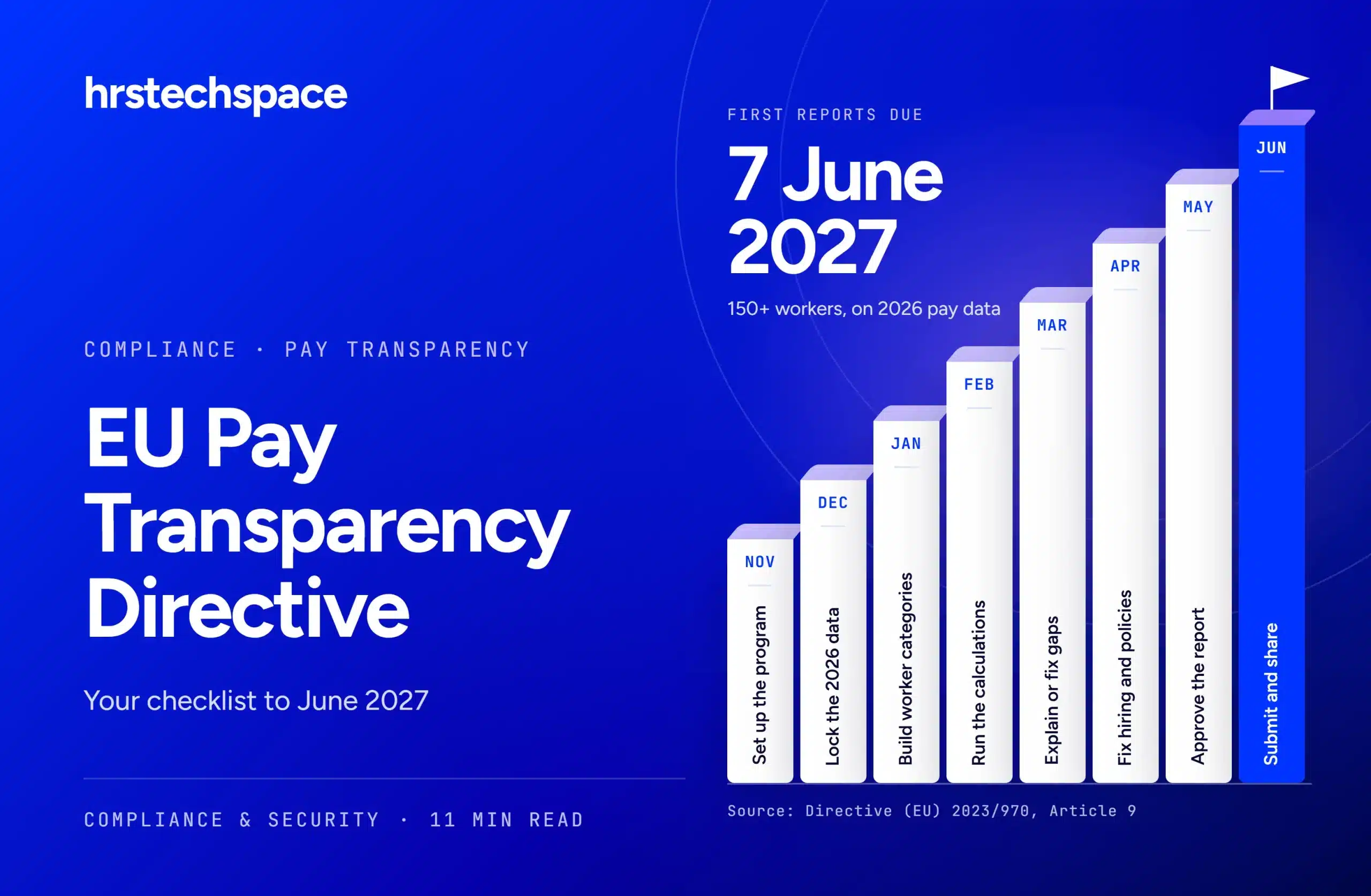
The EU Pay Transparency Directive passed its transposition deadline on 7 June 2026, and most member states missed it. That has led some employers to slow down. It should not. The first pay gap reports cover calendar year 2026, which is almost over, and the European Commission said in May 2026 that it does not plan to delay the directive.
This checklist is built for HR, reward, and HRIS teams that need a plan they can start on Monday. It covers who reports and when, the obligations that reach beyond reporting, and what to finish in each month from November 2026 to June 2027.
| Quick answer: The EU Pay Transparency Directive (Directive (EU) 2023/970) requires employers in the EU to disclose pay ranges to job applicants, stop asking about pay history, make pay-setting criteria available, answer worker requests for pay information, and, from 100 workers, report gender pay gap data. Employers with 250 or more workers report by 7 June 2027 and every year after. Employers with 150 to 249 workers also report by 7 June 2027, then every three years. Employers with 100 to 149 workers start by 7 June 2031. |
Who reports under the EU Pay Transparency Directive, and when
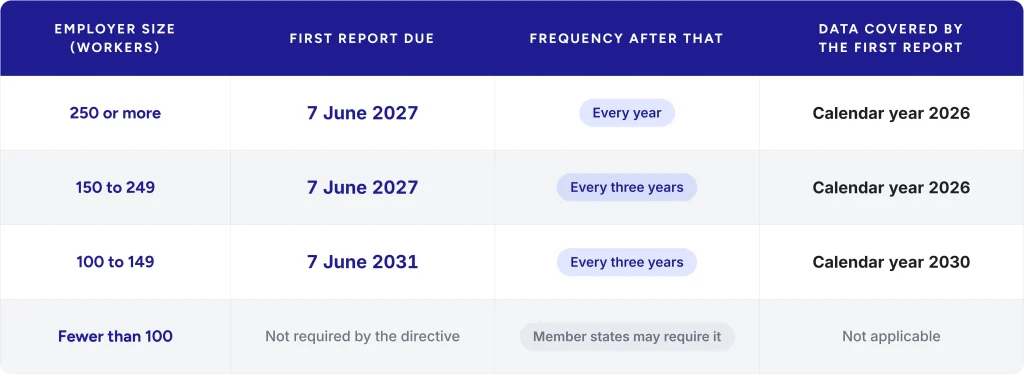
The reporting dates come from Article 9 of the directive. National laws can set earlier dates or lower thresholds, so check each country where you employ people.
Where transposition stands in October 2026
According to Ius Laboris, updated on 5 October 2026, only a small group of countries had transposed the directive in full, including Italy and Slovakia. Bulgaria, Cyprus, the Czech Republic, France, the Netherlands, Portugal, and Spain had published drafts at different stages. Germany, Hungary, and Ireland were still at early steps.
On 22 May 2026, the Commission said it does not envisage including the directive in any “stop-the-clock” or omnibus simplification measure, as reported by Ius Laboris. Late national laws do not move the reporting year. Where a country has not transposed, employers can still face claims based on the directive’s equal pay principles, and national rules may arrive with short notice.
Status changes quickly. Our follow-up article tracks transposition country by country after the deadline.
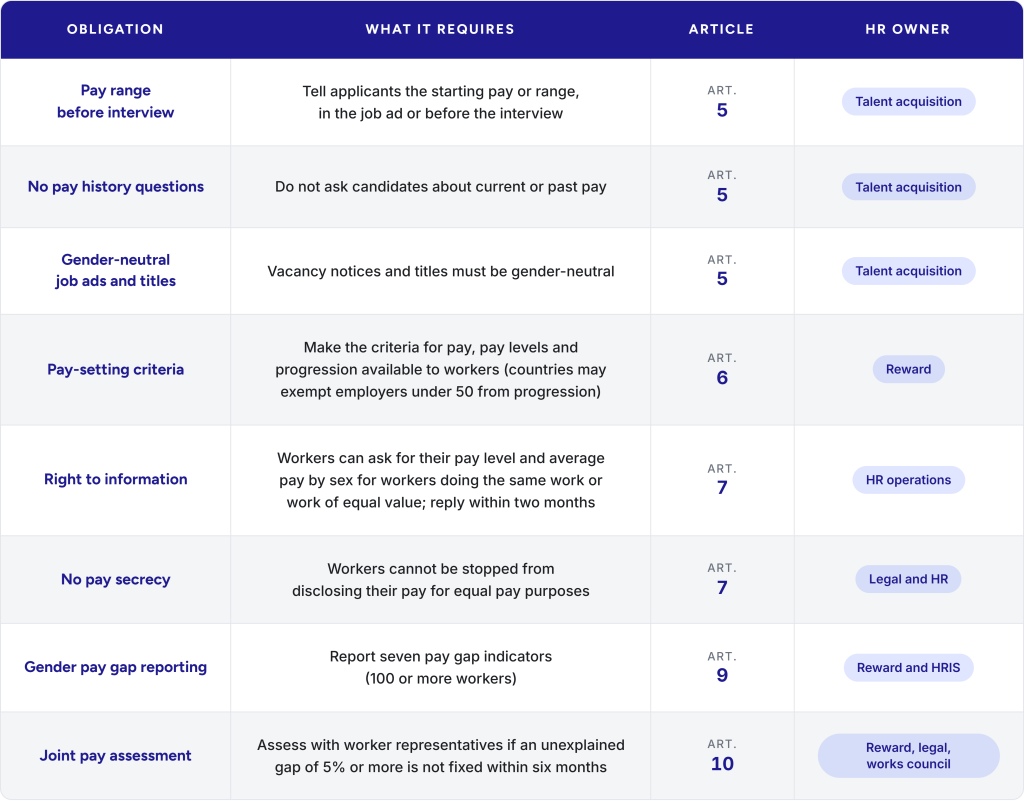
The eight obligations, beyond the report
Reporting gets the attention, but most of the directive changes everyday HR work. These obligations apply to employers of every size unless a country exempts small employers.
What goes into the pay gap report?
Article 9 sets seven indicators. Each one needs clean data by sex and by category of worker:
- The gender pay gap
- The gender pay gap in complementary or variable components, such as bonuses
- The median gender pay gap
- The median gender pay gap in complementary or variable components
- The share of female and male workers receiving complementary or variable components
- The share of female and male workers in each quartile pay band
- The gender pay gap by category of worker, broken down by ordinary basic wage and complementary or variable components
“Pay” is broad. It covers the basic wage plus any other cash or in-kind benefit, such as bonuses, overtime, allowances, company cars, and some pension contributions. Missing benefit data is the most common reason first calculations are wrong.
The month-by-month EU Pay Transparency Directive checklist
November 2026: Set up the program.
- Name an executive sponsor and a program owner from reward or HR operations.
- List every EU entity, its headcount, and the country rules that apply.
- Confirm which entities report in June 2027 (150 or more workers).
- Brief works councils and employee representatives early, where they exist.
December 2026: Lock the 2026 data.
- Agree on the pay elements included in “pay” for each country.
- Pull full-year 2026 pay data, including bonuses, allowances, and benefits in kind.
- Make sure every worker record has sex, entity, job, grade, and working hours.
- Keep a frozen copy of the year-end data for audit.
January 2027: Build worker categories
- Group roles into categories of work of equal value, using skills, effort, responsibility, and working conditions.
- Document the job evaluation method and who approved it.
- Map every worker to one category.
February 2027: Run the first calculations.
- Calculate all seven indicators for each reporting entity.
- Flag every category with a gap of 5% or more.
- Check the results with a second analyst or a pay equity tool.
March 2027: Explain or fix the gaps
- For each flagged gap, document the objective, gender-neutral reasons, or plan a correction.
- Budget pay adjustments where gaps cannot be justified.
- Brief leadership on likely findings before anything is published.
April 2027: Fix hiring and policies
- Add pay ranges to job ads or the pre-interview stage in every EU country.
- Remove pay history questions from application forms, ATS templates, and recruiter scripts.
- Publish pay-setting and progression criteria to workers.
- Set up a process and template to answer worker pay information requests within two months.
May 2027: Prepare and approve the report
- Draft the report in the format each national authority requires.
- Get legal review and management sign-off.
- Prepare manager talking points and employee communications.
June 2027: Submit and communicate
- Submit by 7 June 2027, when national law follows the directive’s dates.
- Share the results with workers and their representatives.
- Start a joint pay assessment where a 5% gap remains unexplained and unfixed after six months.
Systems you will need to change
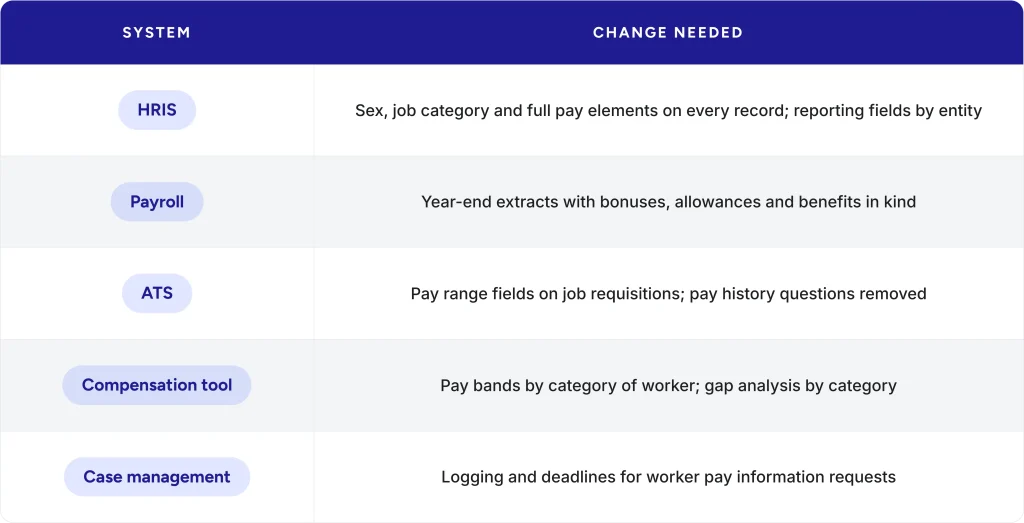
Our guide to pay equity software compares the tools that calculate the indicators and model corrections. For the wider people data foundation, see our guide to workforce analytics platforms, and if you are changing your ATS, our list of the best ATS software notes which tools support pay range fields.
FAQs:
When do the first EU pay transparency reports have to be filed?
Employers with 150 or more workers must report by 7 June 2027 on 2026 data, under the directive’s timeline. Employers with 100 to 149 workers start by 7 June 2031.
Has the EU Pay Transparency Directive been delayed?
No. The transposition deadline was 7 June 2026, and in May 2026 the Commission said it does not plan to delay the directive.
What happens if our pay gap is above 5%?
If a gap of 5% or more in a worker category is not justified by objective, gender-neutral criteria and not fixed within six months, you must run a joint pay assessment with worker representatives.
Do small employers have to comply?
Employers under 100 workers do not have to report under the directive, but pay range disclosure, the pay history ban, and the right to information still apply.
Can we still ask candidates about their current salary?
No. The directive bans asking applicants about their pay history.
Does the directive apply if our country has not transposed it yet?
National laws set the detailed rules, so check each country. Plan for the directive’s dates, because late laws often arrive with short deadlines.