

From June 2027, thousands of EU employers will have to report what they pay women and men. They will also have to explain any gap of 5% or more and tell employees how their pay compares with colleagues doing similar work. Almost every compensation and HR product now carries a “Directive-ready” badge.
That badge hides real differences. Some tools are excellent at pay gap statistics but say little about how you group jobs. Others handle salary bands and benchmarking but leave employee information requests to HR. Several HR suites produce the report and stop there.
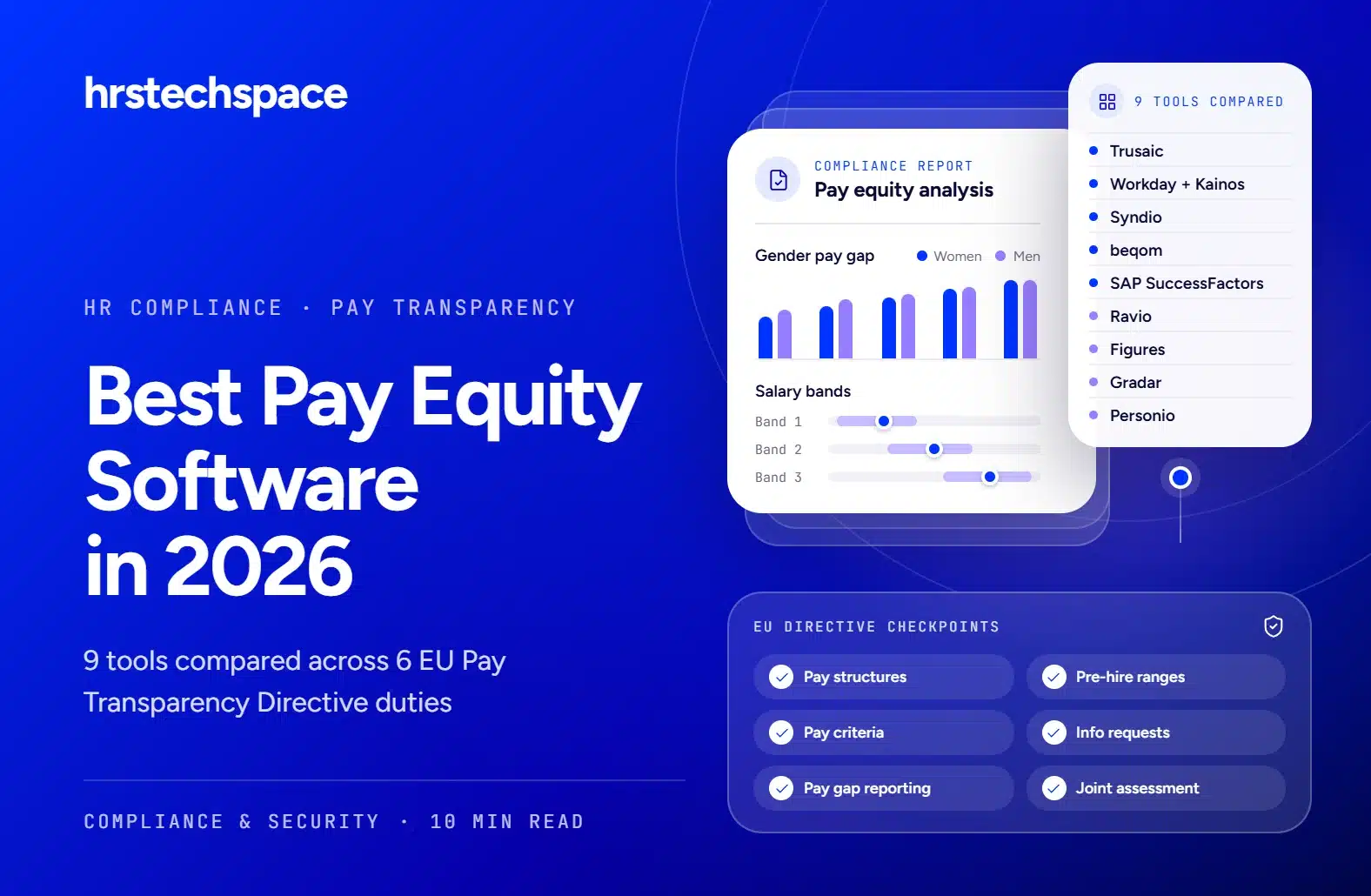
This guide maps nine pay equity software options against the six duties the EU Pay Transparency Directive actually places on employers. You will see where each tool helps, where it is silent, and which combination fits your company size.
| Quick answer: The best pay equity software is the one that covers the directive duties your HR team cannot handle in a spreadsheet. Trusaic and the Workday analyser built by Kainos document the most duties, followed by Syndio, Beqom and SAP SuccessFactors. Ravio and Figures suit European companies that also need salary benchmarking, and Gradar is the job evaluation specialist. Employers with 250 or more workers should choose a tool by early 2027 to report 2026 pay data by 7 June 2027. |
The 9 tools at a glance
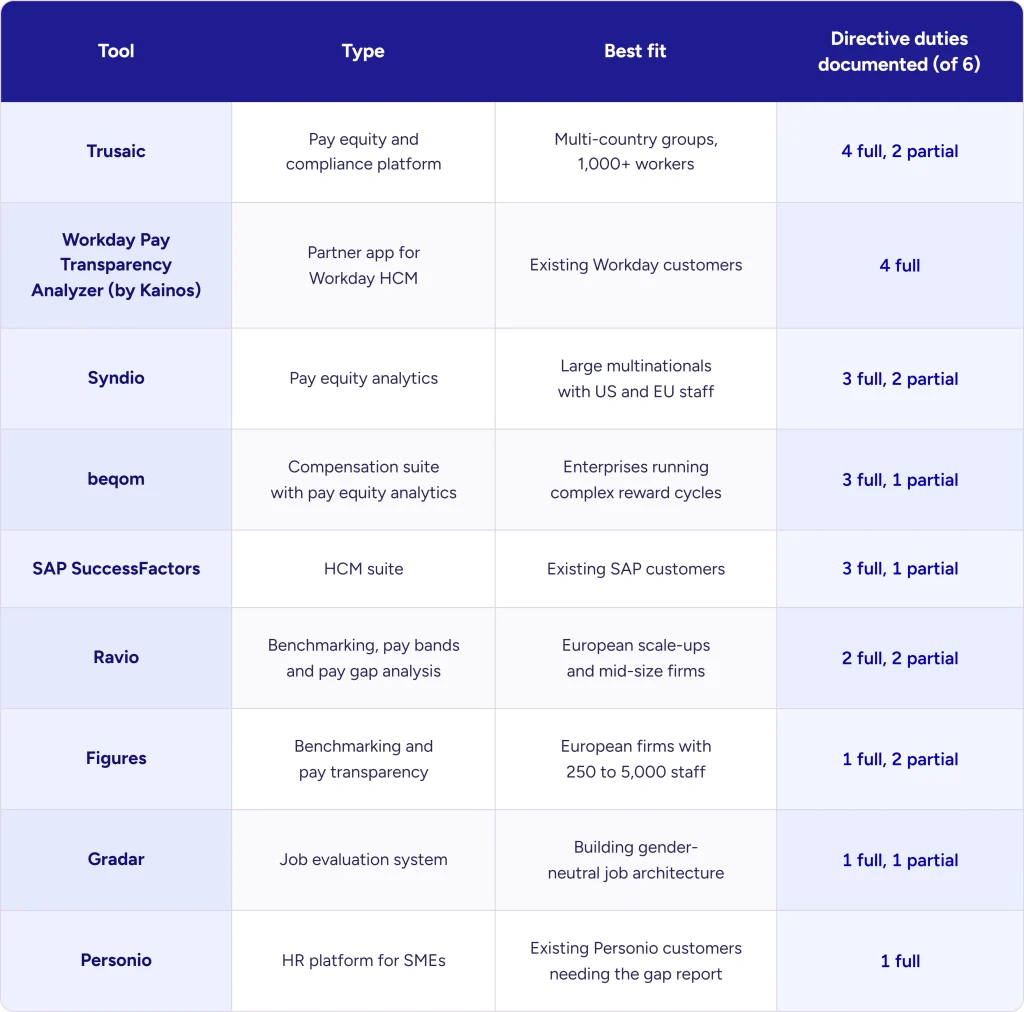
Coverage is based on each vendor’s public documentation, checked on 7 October 2026. “Full” means the duty is clearly described; “partial” means part of it is covered. A missing duty means we found no public documentation, not that the feature cannot exist. Ask in the demo.
What the EU Pay Transparency Directive asks employers to do
Directive (EU) 2023/970 sets six practical duties. Pay equity software can help with all of them, but very few tools cover every one.
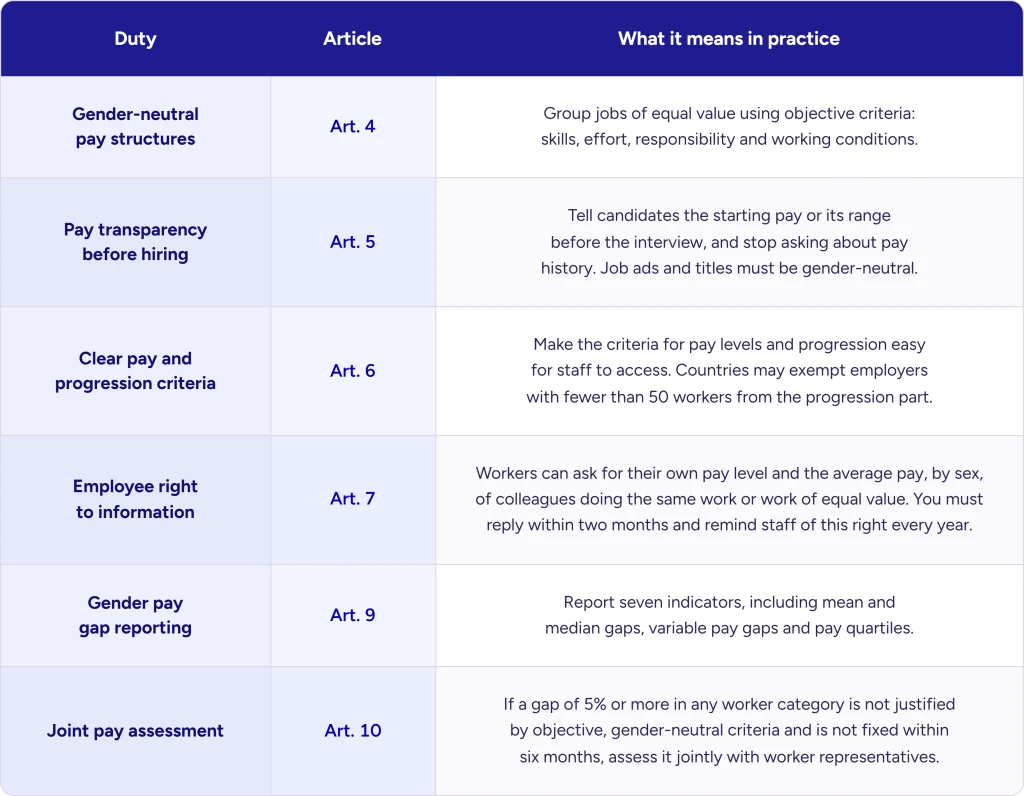
Article 5 also reaches your recruiting tools. Before you buy anything new, check whether your applicant tracking system can show pay ranges in job ads.
Who reports, and when?
- 250 or more workers: first report by 7 June 2027, covering 2026, then every year.
- 150 to 249 workers: first report by 7 June 2027, then every three years.
- 100 to 149 workers: first report by 7 June 2031, then every three years.
- Fewer than 100 workers: no reporting duty under the Directive, though national laws can go further. The duties on pay ranges, criteria and information requests still apply.
That first point matters most right now. If you have 250 or more workers, the pay data you are generating today is the data you will report next June.
[IMAGE: eu-pay-transparency-timeline.png, timeline from June 2023 adoption to the 2031 reporting start]
Where national laws stand in October 2026
Member states had until 7 June 2026 to turn the directive into national law. Most missed the date. According to Lockton’s status tracker of 25 September 2026:
- Italy, Lithuania, Malta and Slovakia have full laws in force.
- Greece’s law entered into force on 6 July 2026, with most employer duties starting on 1 November 2026.
- Estonia and Poland have brought in parts of the Directive, mainly the pre-hiring rules.
- Around 13 countries, including France, Spain, the Netherlands and Portugal, have published drafts. Many target 1 January 2027.
- Seven, including Germany and Austria, had published no draft. Sweden has asked for the directive to be postponed and renegotiated.
Late transposition is not a reason to wait. The reporting year is already running, national laws are expected to follow the directive closely, and some countries, such as Portugal in its August 2026 draft, propose stricter thresholds. Treat the directive as the minimum and check each country where you employ people.
How we evaluated pay equity software
We reviewed each vendor’s public product pages, release notes, help documentation and partner announcements, and checked them on 7 October 2026. This is a documentation-based comparison, not a hands-on test.
Each tool was scored against the six duties above, plus four practical questions:
- Does it connect to the HR and payroll systems most EU employers run?
- Can it report across several countries and languages?
- Does it help you fix gaps, or only find them?
- Who is it built for: SMEs, mid-size firms or multinationals?
Coverage matrix: which tool handles which duty
This is the table to bring into your shortlisting meeting.
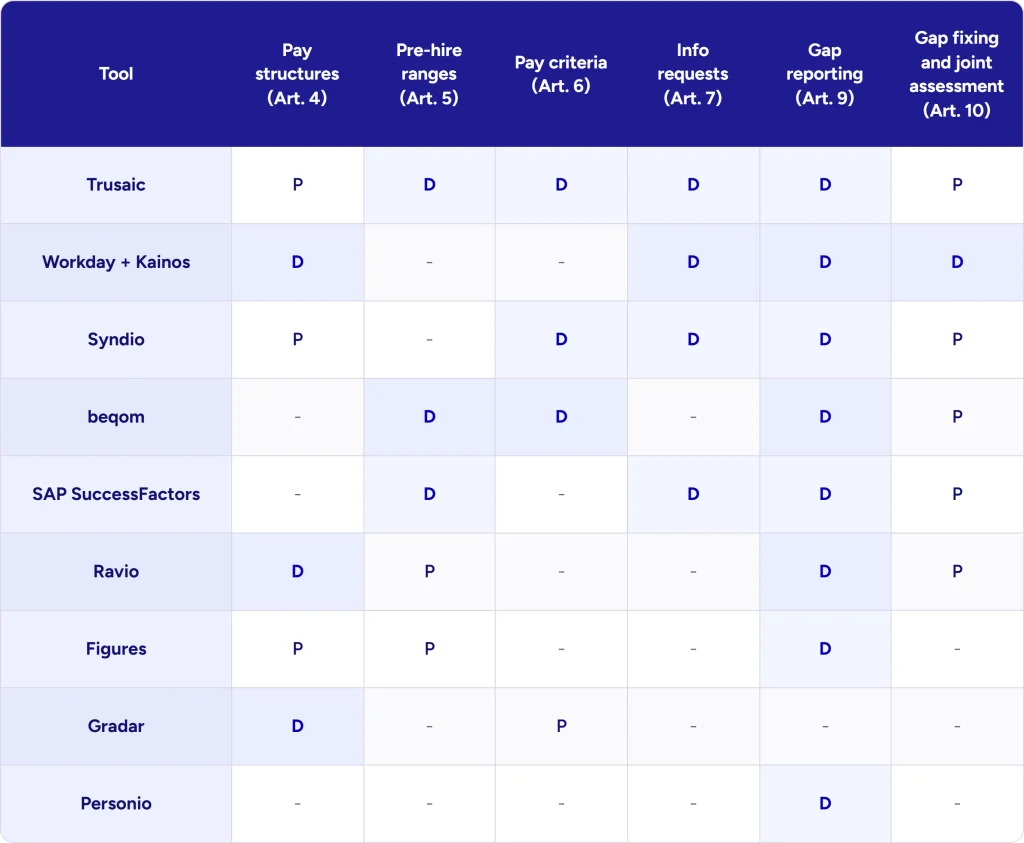
D = documented. P = partial. A dash means ‘not found’ in public documentation on 7 October 2026. For Article 10, “partial” means the tool models the cost of closing gaps but does not describe a joint pay assessment workflow.
Two patterns stand out. First, gap reporting is now table stakes: every tool except Gradar covers it. Second, the duties that cause the most work for HR, Article 4 job architecture and Article 7 information requests, are where coverage thins out.
[IMAGE: pay-equity-software-coverage-matrix.png, heat grid version of the table above]
Three problems no software will solve for you
Buying a tool before these are in place is the most common way to waste the first six months.
1. Messy pay data
The Directive’s definition of pay is broad. It covers base salary plus variable and complementary pay, including bonuses, overtime and benefits in kind. If that data sits in payroll, a bonus spreadsheet and a benefits portal, the software will only be as accurate as your merge. Budget time for a data audit before any vendor demo.
2. No agreed job architecture
Every report and every information request depends on which jobs count as equal value. If your grades grew up through promotions and one-off offers, the gap figures will be hard to defend. Fix the job structure first, with a method such as point-factor evaluation, then analyse.
3. No owner for employee requests
Information requests arrive by email, through managers and through works councils. Someone has to log each one, pull the right comparison group and reply within two months. Decide who owns this process before you choose a tool, because it changes which features you need.
Dedicated pay equity platforms
These tools were built for pay equity analysis first. They tend to have the strongest statistics and the clearest audit trail, which matters if a pay gap is ever challenged.
Trussic
Trusaic sells a set of linked products: PayParity for gap analysis, R.O.S.A. for remediation, Salary Range Finder for setting ranges at the point of hire, and RAPTR for producing reports and employee disclosures. Its EU compliance page maps these to Articles 5, 6 and 7, and lists integrations with Workday, SAP, UKG and ADP.
In March 2026, Trusaic announced a partnership with Gradar to add point-factor job evaluation. That fills the Article 4 gap, but through a second vendor.
- Best for: multinationals that need statistics, remediation and employee disclosures in one place.
- Watch for: job evaluation depends on the Gradar partnership, so confirm how the two products share data.
- Pricing: quote-based; we found no public list prices.
Syndio
Syndio built its name on US pay equity analysis, then added EU features for the directive. These include gap analysis with budgeting against the 5% threshold and right-to-information reports in all 24 official EU languages. There is also a pay policies heatmap that shows which factors actually drive pay and directive reporting inside its PayEQ product.
- Best for: large employers with staff in both the US and the EU who want one methodology for both.
- Watch for: we found no public documentation of pay range tools for job ads or a job evaluation method.
- Pricing: quote-based.
become
Beqom is a compensation management suite used for salary reviews, bonuses and incentives. It has acquired PayAnalytics, a pay equity analytics tool founded in 2016, and now describes features for disclosing pay ranges, explaining pay structures and running gap analyses.
- Best for: enterprises that want pay equity checks built into merit and bonus cycles, so new gaps are caught before they are approved.
- Watch for: employee information requests and job evaluations are not described in the public material we reviewed.
- Pricing: quote-based.
European pay transparency specialists
These vendors grew up in Europe. They pair pay gap analysis with salary benchmarking or job evaluation, which helps with the harder question the Directive raises: is our pay structure fair in the first place?
Ravio
Ravio combines live salary benchmarking with internal pay analysis. Its May 2026 product overview covers mapping roles to a standard levelling framework and checking gender balance inside pay bands. It also reports mean and median gaps, adjusted and unadjusted, and models the cost of closing them.
- Best for: European tech companies and scale-ups building pay bands and reporting at the same time.
- Watch for: information requests and the joint assessment process are not described.
- Pricing: quote-based.
Figures
Figures, based in France, offers salary benchmarking (with data from a partnership with Mercer), salary bands, pay gap reporting and what it calls pre-filled EU compliance templates. By its own description, it targets European companies with 250 to 5,000 employees and is not designed for organisations under 150. It lists more than 20 European HRIS connectors.
- Best for: mid-size European employers who want benchmarking and the gap report from one tool.
- Watch for: below 150 employees, look elsewhere by the vendor’s own guidance.
- Pricing: quote-based.
Gradar
Gradar, from the German firm QPM, is a point-factor job evaluation system. It does not try to be a reporting tool. Instead, it answers the Article 4 question every other product assumes you have already solved: which jobs are of equal value? Gradar says more than 500 organisations use it.
- Best for: employers without a defensible job architecture, used alongside an analytics tool such as Trusaic.
- Watch for: you will need a second product for reporting and information requests.
- Pricing: quote-based.
HR suite options
If your HR data already lives in a major suite, its own pay transparency features can be the fastest route to a first report. Check carefully what is native and what comes from a partner.
Workday Pay Transparency Analyzer (powered by Kainos)
This is a partner solution built by Kainos for Workday customers, not a core Workday module. It documents gender-neutral job architecture, unadjusted pay gap analysis through pre-built reports, a secure process for right-to-information requests and support for joint pay assessments.
- Best for: Workday HCM customers who want Directive coverage without moving data out of Workday.
- Watch for: pay ranges for job ads are not mentioned, and you will contract with a partner as well as Workday.
- Pricing: quote-based.
SAP SuccessFactors
In February 2026, SAP announced EU Pay Transparency Insights, part of its People Intelligence package in SAP Business Data Cloud, for gap analysis. SuccessFactors HCM can also generate pay transparency statements that employees open from their profile, and SuccessFactors Recruiting and SmartRecruiters show pay ranges in job postings.
- Best for: SAP customers who want reporting, employee statements and job-ad ranges inside one vendor.
- Watch for: SAP planned the analytics release for the first half of 2026, so confirm it is live in your tenant and which licence it needs.
- Pricing: depends on your SAP agreement.
Personio
Personio’s gender pay gap compliance report calculates total and variable pay gaps, the share of each gender receiving variable pay and pay quartiles, using mean or median. Personio states that the report compares male and female categories only, and that it does not replace legal review of your report under local law.
- Best for: small and mid-size Personio customers who need the core report.
- Watch for: no documented support for job evaluation, information requests or joint pay assessments.
- Pricing: sold in Personio plans; check which plan includes the report.
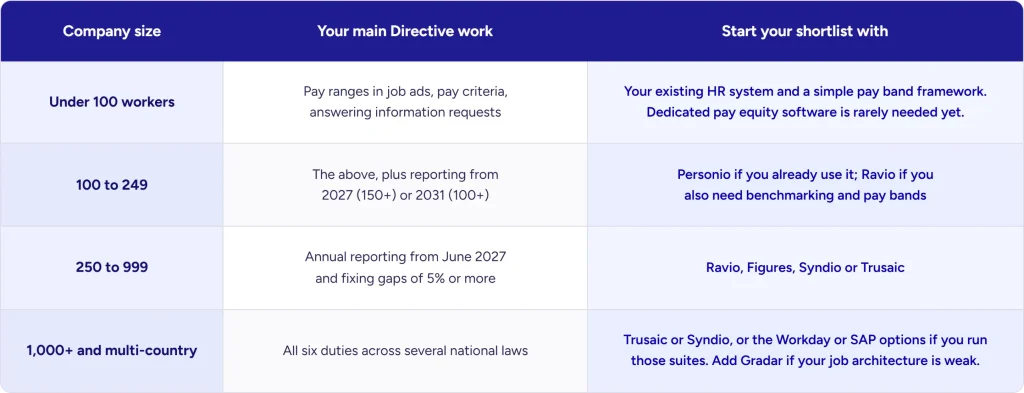
Shortlists by company size
Six questions to ask in every demo
- How does the tool define worker categories of equal value, and can we see the method?
- Which of the seven Article 9 indicators does the report produce out of the box?
- How are employee information requests logged, answered and audited within the two-month deadline?
- When a gap of 5% or more appears, what does the tool do next: explain it, model the fix or support the joint assessment?
- Which national rules does it already support beyond the Directive, for example lower thresholds?
- Where is our pay data stored, and which certifications cover it?
Your timeline to the first report
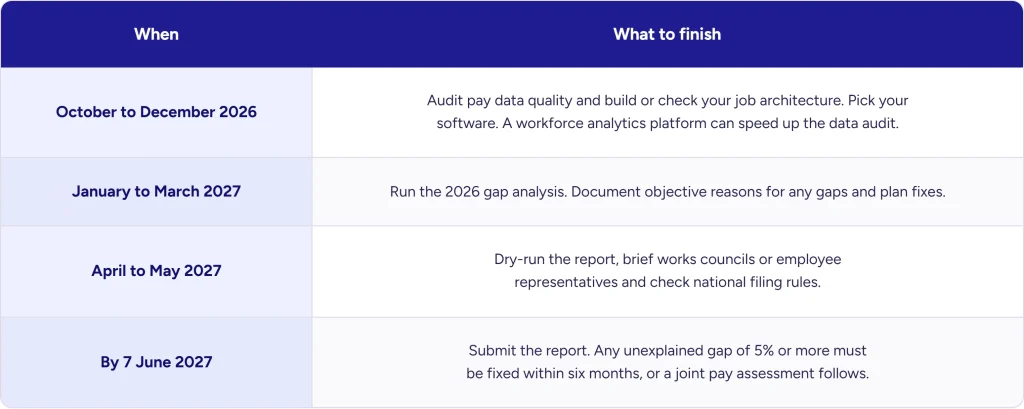
For employers with 250 or more workers, this is the realistic path to 7 June 2027:
FAQs:
What is pay equity software?
Pay equity software analyzes pay by gender and other factors, explains gaps using objective criteria, and supports reporting and fixing them. Under the EU Directive, the better tools also handle job grouping, salary ranges and employee information requests.
When is the first EU pay gap report due?
Employers with 250 or more workers must report by 7 June 2027 on 2026 pay. Employers with 150 to 249 workers also report by 7 June 2027, then every three years, and those with 100 to 149 report from 7 June 2031.
What happens if our pay gap is 5% or more?
You must run a joint pay assessment with worker representatives. That applies when the gap in a worker category has no objective, gender-neutral justification and is not fixed within six months of reporting.
Does the Directive apply if our country has not passed its law yet?
National laws are how the rules reach most employers, and many countries are targeting 2027. Plan as if the Directive applies now, because your 2026 pay data is the first reporting year, and take local legal advice.
Can our HR system handle pay transparency on its own?
It can usually produce the gap report. Few suites document job evaluation or a full process for information requests and joint assessments, so check each duty before relying on one system.
Do companies under 100 employees need pay equity software?
Usually not yet. They have no reporting duty under the Directive but must still share pay ranges before hiring and answer employee information requests.