

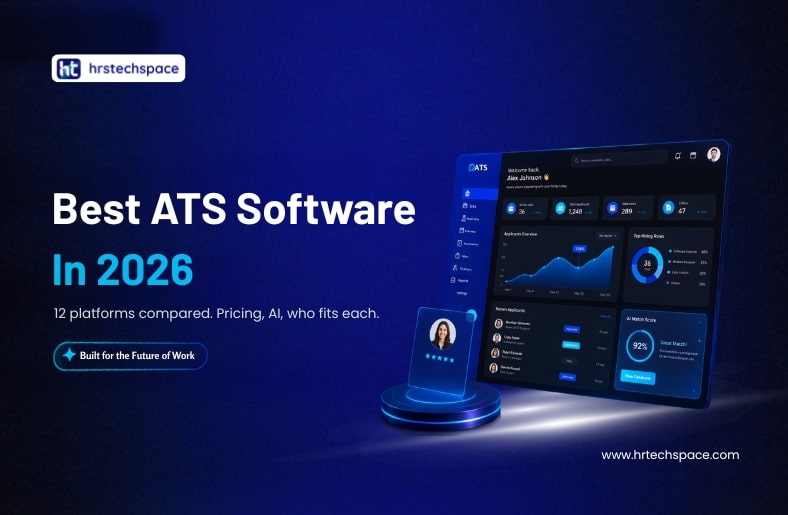
97.8% of Fortune 500 companies now run an applicant tracking system. Yet most HR leaders evaluating the best ATS software in 2026 are about to pick the wrong one for their stage.
The market has shifted faster in the last 18 months than it did in the previous five years combined. SAP acquired SmartRecruiters. Workday absorbed Paradox. iCIMS bought Apli. Three dominant enterprise ATS vendors are now under new ownership, carrying updated product roadmaps and uncertain support trajectories. Meanwhile, Ashby has moved from an interesting startup to the platform every Series B+ tech company evaluates seriously.
This guide compares the 12 best ATS platforms available in 2026, with current pricing, realistic implementation timelines, and a clear answer on who each one is actually built for.
Key Takeaways
- Greenhouse remains the gold standard for structured hiring at mid-market and enterprise scale, with annual costs of $6K to $25K.
- Workable is the top mid-market choice for teams that need full ATS functionality without enterprise complexity, starting at $299/month flat.
- Ashby is the breakout 2026 challenger: fast Workday integration, modern UI, and deep native analytics. Best for tech companies scaling 50 to 500 employees.
- Workday Recruiting dominates enterprise environments of 1,000+ employees where HCM integration matters more than recruiter-first features. Implementation runs 6 to 18 months.
- The most expensive ATS software is rarely the best fit. Match hiring volume and process complexity to the platform first. Price is the last filter, not the first.
How We Selected the Best ATS Software for This List
This is not a complete catalogue of every recruiting software platform on the market. It is a focused shortlist for B2B companies hiring at scale, vetted against four criteria:
- Production scale. Used by at least 200 mid-market or enterprise companies with verifiable customer logos.
- G2 rating of 4.3 or higher as of Q1 2026, with a minimum of 500 verified reviews.
- Active product investment in 2026. Real AI feature releases this year, not a maintenance-only roadmap.
- Defensible AI capability. The 2026 AI features either work as advertised or are not promoted as headline features.
Pricing was pulled from vendor pages, sales conversations, and procurement data from contracts signed in Q1 2026. Where pricing shows as ‘contact sales,’ directional ranges come from buyer-reported data.
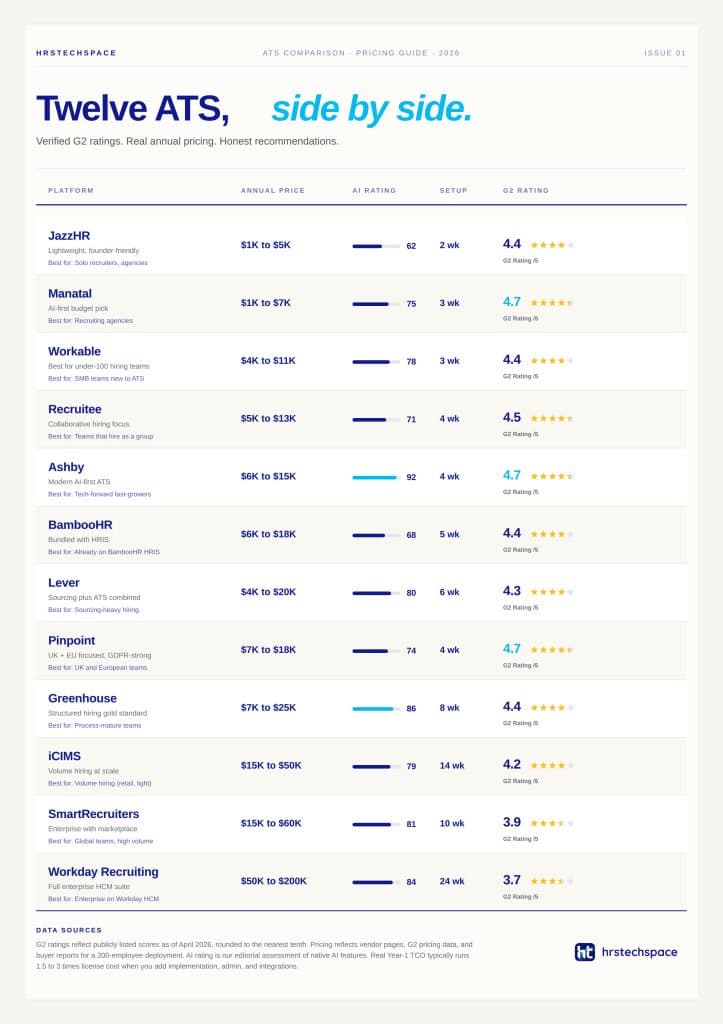
The 12 Best ATS Software Platforms in 2026
1. Greenhouse — Best for Structured Hiring at Scale
Annual cost: $6,000 to $25,000+, depending on company size and modules
Greenhouse is the default choice for mid-to-large B2B companies that take structured hiring seriously. Every pipeline stage can carry required fields, mandatory interview kits, and automated scorecards—enforcing consistency across hundreds of open reqs running simultaneously.
The 2026 standout is Real Talent AI, Greenhouse’s predictive scoring engine. Unlike basic keyword matching, it analyzes candidate responses, experience patterns, and interview feedback to generate success scores. Companies using Real Talent AI alongside structured interviewing consistently report meaningful drops in 90-day attrition.
Strengths
- Most extensive integration ecosystem in the mid-market ATS category—Workday, BambooHR, Rippling, HackerRank, Codility, and every major background check provider
- Structured hiring methodology built into the product, not bolted on after the fact
- Strongest interview kit and scorecard system in the category
- Robust referral and onboarding workflows that bridge recruiting and HR operations
Weaknesses
- The power comes with administrative complexity—proper setup demands significant ongoing admin effort
- Implementation packages add $2,000 to $10,000+ on top of license costs
- Custom pricing can feel opaque during the sales process
Best for: Companies making 30+ hires per year, especially tech startups from Series A onward, and enterprises needing compliance documentation across multiple geographies.
Skip it if you are making fewer than 20 hires per year. You will pay for capability you will never use.
2. Workable—Best All-in-One Mid-Market ATS
Pricing: Starter $299/month | Growth $499/month | Scale $899/month (flat-rate, no per-seat fees)
Workable hits the sweet spot between enterprise complexity and SMB simplicity. Flat-rate pricing is unusual in the ATS software category and protects mid-market teams from the per-seat cost creep that hits Greenhouse and Lever as headcount grows.
The 2026 release of AI Interview Copilot is genuinely useful. It listens to video interviews—with candidate permission—and generates structured notes mapped to evaluation criteria. Recruiters report a 30 to 40 percent cut in interview admin time.
Strengths
- Transparent flat-rate pricing with no per-seat surprises
- Self-serve setup, usable in under a week
- Built-in job board distribution to over 200 free and paid sites
- Strong career site builder and candidate experience tools
- AI Interview Copilot delivers measurable, real-world time savings
Weaknesses
- Less customization depth than Greenhouse for complex organizational structures
- Smaller integration marketplace
- Reporting is functional rather than enterprise-grade
Best for: Growing companies with 50 to 500 employees making 20 to 200 hires per year that need full ATS functionality without enterprise overhead.
Skip it if: You need deeply customized approval workflows or operate in a heavily regulated industry such as finance, healthcare, or the public sector.
3. Ashby—Best Modern ATS for Tech-Company Hiring
Annual cost: $6,000 to $15,000, with most analytics features included at base pricing
Ashby is the breakout recruiting software of 2026 for tech companies. It pairs a modern UI closer to Linear or Notion than any legacy recruiting platform with the deepest native analytics in the category. The Workday integration is completed in two to six weeks without external consultants—a process that takes most other platforms several months.
What customers consistently highlight: implementation speed, support quality, and a product roadmap that ships meaningful AI features rather than just marketing them.
Strengths
- Modern, intuitive UI that drives high recruiter adoption
- Best-in-class analytics included in base pricing—no premium tier required
- Fast Workday integration, typically two to six weeks
- Customer support that still feels personalized at this scale
- Recent partnerships with SHL, Sterling Check, and Naukri signal growing enterprise readiness
Weaknesses
- Younger platform with occasional feature gaps and minor bugs
- Customer base concentrated in tech companies and North America
- Less brand recognition than Greenhouse or Lever in formal enterprise procurement
Best for: Tech companies between 50 and 500 employees that prioritize data-driven hiring and a modern user experience over legacy feature depth.
Skip it if you operate outside tech, in a non-North-American geography with limited Ashby support, or need maximum integration breadth today.
4. Lever—Best CRM-Forward ATS for Proactive Sourcing
Annual cost: $4,000 to $20,000 (scales with CRM add-ons)
LeverTRM (Talent Relationship Management) is one of the few platforms that genuinely combines an applicant tracking system with a candidate relationship management tool. Most ATS platforms manage inbound applications. Lever manages those plus the outbound pipeline of passive candidates you are nurturing for roles that may not yet exist.
For sourcing-heavy teams, that is a meaningful differentiator. Coupa, for example, expanded its team by 40% in six months by leveraging Lever’s CRM for proactive pipeline building.
Strengths
- Strong native CRM for talent pool nurturing
- Excellent self-scheduling and bidirectional calendar sync
- Visual, flexible pipelines that hiring managers actually use
- Smooth, professional candidate experience throughout
Weaknesses
- AI capabilities trail Greenhouse, Workable, and Ashby in 2026
- Less granular scorecard customization than Greenhouse
- Reporting becomes less powerful at very large organizational scale
Best for: Growth-stage companies with 100 to 500 employees running proactive sourcing motions and building talent pipelines before roles formally open.
Skip it if your hiring is purely inbound and structured interview rigor is the top priority.
5. Workday Recruiting — Best for Enterprise HCM Integration
Annual cost: $100,000 to $300,000+ for typical Fortune 500 deployments | Implementation: 6 to 18 months
Workday Recruiting is not a standalone best-in-class ATS software solution. It is the right choice for organizations where tight integration with the broader HCM ecosystem—payroll, benefits, and workforce planning—matters more than recruiter-first features.
The 2025 acquisition of Paradox added conversational AI for high-volume hiring, with automated screening and scheduling at scale. This has meaningfully narrowed the gap with iCIMS and SmartRecruiters for enterprise high-volume use cases.
Strengths
- Unmatched integration with the Workday HCM ecosystem
- Enterprise-grade compliance, security, and global hiring capabilities
- Paradox-powered conversational AI for high-volume automated screening
- Mobile-optimized for both recruiters and candidates
Weaknesses
- Recruiter UX consistently rated weaker than Greenhouse, Lever, or Ashby
- Candidates must create a separate Workday account per employer—a persistent usability complaint
- Implementation cost often equals the annual software fee
- A six- to 18-month rollout is the norm, not an outlier
Best for: Enterprises of 1,000+ employees already standardized on Workday HCM, where data flow and compliance take priority over recruiter-centric features.
Skip it if recruiting capability is your primary need or you have not yet committed to the Workday HCM ecosystem.
6. iCIMS—Best for Enterprise High-Volume Hiring
Annual cost: $15,000 to $140,000+, depending on headcount and modules
iCIMS targets mid-market and enterprise organizations running high-volume or operationally complex ATS software requirements. Its automation depth and configurability are unmatched outside the Big Three (Workday, SAP, Oracle). The 2025 Apli acquisition added AI-driven candidate matching, though full integration is still maturing.
Strengths
- Deep automation purpose-built for high-volume hiring at 1,000+ hires per year
- Multi-location governance and approval chains for global enterprises
- Strong compliance posture designed for regulated industries
- Robust marketplace integrations
Weaknesses
- High learning curve—dedicated administrator is usually required
- Some marketplace integrations carry additional fees beyond certain tiers
- More complex than necessary for most mid-market teams
Best for: Enterprises with 1,000+ employees running high-volume hiring in sectors such as retail, healthcare, and financial services.
Skip it if you are mid-market without dedicated HRIS resources and implementation capacity.
7. SAP SuccessFactors Recruiting — Best for Existing SAP Organizations
SAP SuccessFactors Recruiting—now expanded to include the SmartRecruiters product family following the September 2025 acquisition—is the practical applicant tracking system choice for enterprises already running the SAP HXM stack.
Strengths
- Tight SAP HXM integration with minimal configuration overhead
- Strong global compliance and localization capabilities
- The SmartRecruiters acquisition may strengthen mid-market positioning over the next 18 months
Weaknesses
- Recruiter UX trails the modern category leaders
- Complex, non-transparent licensing structure
- Post-acquisition product roadmap uncertainty warrants hard questions before signing
Best for: Enterprises standardized on SAP HXM that want to consolidate recruiting under a single vendor.
Skip it if you are not already on SAP and are evaluating best-in-class ATS software on its own merits.
8. BambooHR ATS — Best HR and ATS Combined for SMB
Pricing: Bundled with BambooHR HRIS, typically $250 to $700/month total for SMB teams
If you already need HR software and you are hiring at modest volume, combining your ATS with your HRIS on a single platform makes operational sense. BambooHR’s ATS handles basic requirements cleanly and integrates with the rest of the BambooHR ecosystem: PTO, performance management, and reporting.
Strengths
- Single vendor, single bill, single login
- Clean, accessible UI with minimal training required
- Fast self-directed implementation
Weaknesses
- Not competitive with standalone ATS software for serious recruiting operations
- Limited automation for high-volume hiring
- Sourcing and CRM features are minimal
Best for: SMBs under 200 employees making fewer than 30 hires per year who need HR software regardless.
Skip it if hiring is a strategic priority if you are making 50 or more hires per year.
9. Zoho Recruit—Best Budget Mid-Market ATS
Pricing: Free (1 user) | Standard $30/user/month | Professional $60/user/month | Enterprise $80/user/month
Zoho Recruit delivers respectable depth as an applicant tracking system at a fraction of Greenhouse pricing. The broader Zoho ecosystem—CRM, Books, and Desk—provides genuine cross-functional value for teams already running other Zoho products.
Strengths
- Most affordable serious ATS software in the category
- Free tier genuinely usable for solo recruiters
- Strong Zoho ecosystem integration
- Straightforward self-serve setup
Weaknesses
- UI quality varies noticeably between modules
- Smaller integration marketplace than Greenhouse
- Customer support reviews are inconsistent at lower plan tiers
Best for: Cost-conscious mid-market B2B teams of 50 to 300 employees where budget pressure outweighs feature depth requirements.
Skip it if: You need premium support responsiveness or complex enterprise customization.
10. Rippling ATS — Best All-in-One HR, Payroll, and ATS Platform
Pricing: Custom, typically combined with the full Rippling platform
Rippling’s ATS is part of its unified HR, IT, and finance platform. The single-data-source advantage is real: a hire flows from candidate to fully onboarded employee with zero manual data re-entry between systems. Rippling’s 2026 G2 rating of 4.8 out of 5 puts it at the top of the ATS software category for overall usability.
Strengths
- Single platform spanning HR, IT, Payroll, and ATS with no data re-entry
- Highest G2 rating in the ATS category
- Strong automation across the full employee lifecycle
Weaknesses
- Custom pricing with no published rates
- Best value only when committing to multiple Rippling products
- Less recruiting-specialist depth than Greenhouse or Ashby for complex hiring programs
Best for: Growth-stage companies of 50 to 500 employees consolidating HR, IT, and payroll on a single platform.
Skip it if you only need an ATS and prefer a best-in-class specialist tool.
11. JazzHR—Best for SMB Simplicity
Pricing: Hero $499/month | Plus $699/month | Pro $899/month
JazzHR is designed for small businesses that want a real ATS software solution without enterprise pricing or enterprise learning curves.
Strengths
- Clean, simple interface that new users adopt quickly
- Affordable flat-rate pricing
- Fast setup with strong SMB-scale support
Weaknesses
- Limited customization options
- Smaller integration ecosystem
- Less feature depth than Workable at comparable price points
Best for: Small businesses under 100 employees making 10 to 40 hires per year.
Skip it if: You need scalability beyond roughly 100 employees or require enterprise-grade features.
12. SmartRecruiters (now SAP) — Best for Enterprise Marketplace Extensibility
Following the September 2025 SAP acquisition, SmartRecruiters now sits inside the SAP product family. Its marketplace extensibility and collaborative hiring features remain strong. The post-acquisition product roadmap is still being defined.
Strengths
- Strongest marketplace extensibility in the enterprise ATS category
- Excellent collaborative hiring experience for hiring managers
- Good fit for enterprises that value a consensus-driven selection process
Weaknesses
- Post-acquisition uncertainty around product investment pace
- Pricing now follows SAP’s enterprise model
- Ask hard questions about the 24-month roadmap before signing
Best for: Enterprises that valued SmartRecruiters’ collaboration-first approach and are comfortable with SAP-paced product evolution.
Skip it if you need fast roadmap velocity or are not already operating within the SAP ecosystem.
How to Choose the Right ATS Software in 2026
Skip the feature comparison spreadsheet. Most ATS software purchasing mistakes come from a single root cause: mismatching the platform to actual hiring volume and process complexity. Work through this four-step framework before scheduling your first demo.
Step 1: Define Your Hiring Volume
| Annual Hiring Volume | Recommended Platforms |
| Under 20 hires/year | Workable Starter, JazzHR, Zoho Recruit, BambooHR ATS |
| 20–80 hires/year | Workable Growth, Greenhouse, Ashby, Lever |
| 80–200 hires/year | Greenhouse, Ashby, Lever, iCIMS |
| 200+ hires/year | iCIMS, Workday Recruiting, SAP SuccessFactors |
Step 2: Identify Your Primary Pain Point
- Inconsistent hiring quality: structured hiring platforms (Greenhouse, Ashby)
- Difficulty attracting passive candidates: CRM-forward platforms (Lever, Ashby)
- Integration complexity across HR systems: all-in-one platforms (Rippling, Workday) or BambooHR ATS
- Hiring process too slow: workflow automation leaders (Workable, Ashby)
Step 3: Audit Your Existing Tech Stack
Before signing, list every system the new applicant tracking system must connect with: HRIS, payroll, background check providers, e-signature tools, calendar integrations, communication platforms like Slack, and assessment tools such as HackerRank or Codility. Verify integration depth before the contract is signed. Some listed integrations are true bidirectional data syncs; others are manual exports in disguise.
Step 4: Budget Beyond the License Fee
The total cost of ownership for year 1 typically runs
- Light setup (Workable, Ashby, Zoho, JazzHR): 1.1x to 1.3x the license cost
- Medium setup (Greenhouse, Lever, BambooHR): 1.3x to 1.7x the license cost
- Heavy setup (Workday, iCIMS, SAP): 1.5x to 2.0x the license cost
For Workday and iCIMS at the enterprise tier, implementation alone can equal the annual license fee.
Common ATS Mistakes to Avoid
The same five errors appear repeatedly across B2B ATS software rollouts:
- Buying for a future you have not reached. A 50-person team purchasing Workday ‘because we will grow into it’ almost always regrets the cost and complexity before that growth arrives.
- Skipping data migration planning. Historical ATS data is messier than expected. Start migration planning four to six weeks before go-live.
- Underestimating change management. Recruiters revert to spreadsheets when the new platform is harder than the old workflow. Ongoing training and adoption monitoring matter as much as the software itself.
- Ignoring DEI and bias mitigation features. AI-driven scoring can introduce unintentional bias. Greenhouse, Workable, and Ashby all include bias-mitigation tools. Use them.
Prioritizing AI features over fundamentals. Every vendor has an AI story in 2026. The data model, automation engine, and integration reliability matter far more over a three-year horizon.
Final Verdict
The 12 platforms in this guide cover every meaningful B2B hiring motion in 2026. There is no objectively best ATS software for every company. There is only the right one for your team’s hiring volume, process maturity, and existing technology stack.
Under 50 employees, 10–30 hires/year: start with Workable or Zoho Recruit; both scale comfortably to 200+ employees. 50 to 500 employees at a modern tech company: take Ashby seriously. 500+ employees with enterprise complexity: Greenhouse wins on hiring quality, Workday on HCM integration, and iCIMS on hiring volume.
The point that gets lost in every ATS evaluation: commit, implement properly, and stay the course for at least 24 months. Every ATS software platform on this list works when paired with disciplined processes, defined adoption metrics, and consistent recruiter usage. None of them work when those things are absent.
Pick your top two from the shortlist above. Schedule demos with both. Bring three hiring managers and at least one recruiter to each. The people who use the tool every day should have the loudest voice in the final decision.
FAQs:
What is the best ATS software in 2026?
There is no single correct answer. Fit depends on hiring volume, process complexity, and existing tech stack. Greenhouse wins for structured hiring at mid-market and enterprise scale. Workable wins for transparent flat-rate pricing. Ashby is the strongest modern challenger for tech companies. Workday Recruiting dominates enterprise HCM-integrated environments.
How much does ATS software cost in 2026?
Pricing ranges from free (Zoho Recruit’s basic tier) to over $300,000 per year for Workday and iCIMS at an enterprise scale. Most growing mid-market B2B teams spend $6,000 to $25,000 per year on a serious ATS platform.
How long does ATS implementation take?
Light platforms such as Workable, JazzHR, and Zoho Recruit can go live in one to two weeks. Mid-market platforms like Greenhouse, Lever, and Ashby typically take three to eight weeks. Enterprise platforms like Workday and iCIMS run four to 18 months depending on customization depth.
Is Greenhouse still the best ATS for B2B companies in 2026?
For mid-market and enterprise B2B organizations with structured hiring needs, yes. For lean tech teams under 200 employees, Ashby has become a credible alternative with a better UI and faster implementation. For SMBs, Workable offers stronger value at flat pricing.
Which ATS software has the best AI features in 2026?
Greenhouse’s Real Talent AI (predictive scoring) and Workable’s AI Interview Copilot (automated structured interview notes) are the most-used AI features customers report as delivering tangible value. Workday’s Paradox integration is strongest for enterprise-scale automated screening and scheduling.
How did the 2025 ATS acquisitions change the market?
Three major acquisitions—SAP buying SmartRecruiters, Workday absorbing Paradox, and iCIMS acquiring Apli—significantly consolidated the enterprise recruiting software market. Buyers should ask hard questions about product roadmaps before signing multi-year contracts with any acquired platform.
Can I switch ATS software later if I outgrow my current one?
Yes, but for any team managing more than 100 active reqs, it is a three- to six-month project. Plan for data export, field mapping, integration rebuilds, retraining, and a temporary dip in recruiter productivity. The switching cost is real. Choose carefully now.
1 Comment
Pingback: Best Pay Equity Software in 2026: 9 Tools Mapped to the EU Pay Transparency Directive - hrstechspace