

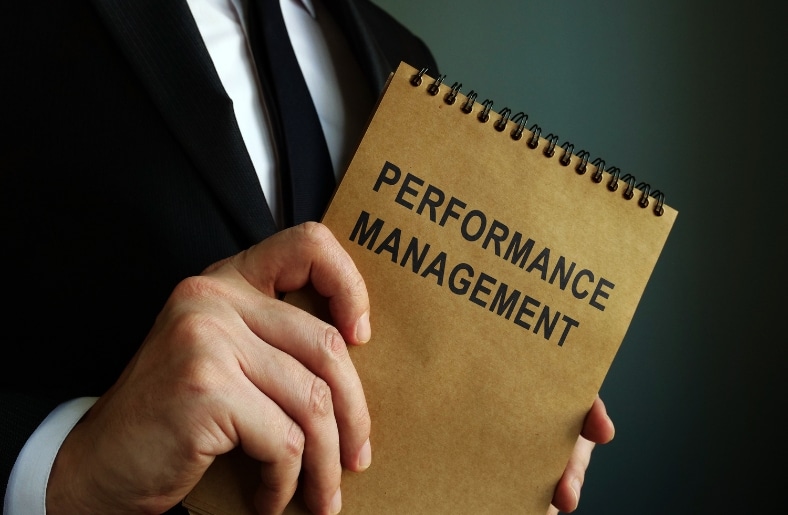
Performance management is no longer a support function anymore. For today’s organizations, it is a direct factor in execution, engagement, and long-term growth. As teams increase in size and work becomes more dynamic, most companies find that informal feedback and annual reviews are no longer enough.
A well-designed performance management solution provides the structure needed to manage performance continuously, align work with strategy, and support employee development without adding unnecessary complexity.
This article explains what a performance management solution truly involves, when organizations need one, and how Leapsome implements performance management in a way that drives real results.
What Is a Performance Management Solution in Practice
A performance management solution is a system that helps organizations consistently plan, monitor, evaluate, and improve employee performance. It is a combination of intelligible processes and technology that helps the talk of performance happen more often, rather than only once to assess.
In practice, this means:
- Expectations are articulated and made visible
- Feedback is regular as opposed to once in a while
- Performance data is used for making decisions
- Development is part of the performance cycle
According to Harvard Business Review, businesses that eliminate annual reviews in favor of consistent performance management practices show improved execution and also higher levels of trust from the employees, particularly in fast-changing environments.
Signs Your Organization Needs a Performance Management Solution
Many companies delay formalizing performance management until there is a problem. Common warning signs include:
- Employees are Unclear about Priorities
- Feedback-depends on the individual manager’s style.
- Performance reviews are deemed to be subjective or inconsistent
- High performers believe they are unappreciated
- Coaching—If managers have difficulty with coaching effectively
When performance management lacks in structure, there are uneven outcomes A dedicated performance management solution addresses these issues by creating consistency without removing flexibility.
Why Traditional Models of Performance Management Don’t Work with Modern Teams
Traditional models of performance were developed for predictable work environments. Changing Purpose Teams in today’s world are characterized by changing objectives, cross-functional work, and diddy change.
These models will fail as they:
- Receive A Too Late Capture Performance
- Depend on memory and not evidence
- Focus on evaluation and not improvement
- Create stress even instead of creating clarity
Gallup research is consistent in their findings that employees who receive frequent, meaningful feedback do better and are more engaged than employees who do not. Engagement, in turn, is very closely linked to productivity and retention.
The Core Components of an Effective Performance Management Solution
High-performing organizations make performance management purposeful. The best solutions have been built around the following components.
Corporate Learning Feedback and Coaching
Feedback is to be used to guide performance as work is occurring. Continuous feedback permits course correction to be made quicker and positive behavior to be reinforced.
Organizations that make regular check-ins a part of the norm build learning-oriented cultures as opposed to evaluation-driven cultures.
Alignment of Goals That Lead to Execution
Clear goals are one way to relate the day-to-day work to business consequences. Modern performance management solutions support structured goal-setting frameworks such as OKRs to ensure alignment across teams.
When goals are transparent:
- Employees have an understanding of impact
- Teams stay focused
- Progress is measurable
This helps to change performance management from subjective assessment to outcome-based.
Fair and research-based Practice Evaluations
Performance reviews are not irrelevant, as they become informed with data collected over a cycle. Effective review processes include self-reflection, peer input, and manager assessment based on actual indicators of performance.
The Society for Human Resource Management emphasizes the importance of performance reviews for development and decision-making, and not just documentation.
Engagement Insights that Lead to Leadership Decisions
Engagement is directly related to performance. Modern performance management solutions incorporate engagement measurement to help leaders understand sentiment and address issues early.
Deloitte research reveals that organizations using people analytics to make decisions have better leadership effectiveness and retention.
Development Incorporated in Performance Management
Performance management should lead to growth. When insights on performance are applied to learning and development, employees know how to improve and move up.
LinkedIn’s workplace learning research gives it its report name because it is a source of development opportunities that is a big contributor to employee retention as well as long-term performance.
Why Growing and Distributed Teams are Best
As organizations expand and increase in size, the complexity of performance management increases. Without structure, inconsistency is increased across managers and teams.
A performance management solution helps organizations:
- Maintain consistency across locations
- Support new managers
- Preserve culture during growth
- Make fair and evidence-based decisions
This is especially important for remote and hybrid teams, where performance needs to be determined by results and not visibility.
How Leapsome Is Supporting Modern Performance Management
Leapsome is a people enablement platform that aims to support and circulate continuous performance, engagement, and development in a single system. It is a manifestation of modern principles of performance management that brings together key processes instead of being a separate process.
Leapsome contributes to performance management by enabling one to:
- Constant feedback and recognition that is built into the daily work
- Company, team and individual level Goal and OKR alignment
- Customizable performance reviews with the help of the actual performance data
- Takeable information engagement surveys
- Development paths that have a direct relationship to performance outcomes
By connecting these elements, Leapsome functions as a comprehensive performance management solution rather than a standalone HR tool.
Business Outcomes of Implementing a Performance Management Solution
Organizations that implement modern performance management solutions typically experience:
- Higher employee engagement
- More effective managers
- Clarity in execution of Strategy
- Improved Retention of Top Performers
- Increased confidence in people’s decisions
Performance management then becomes a growth enabler as opposed to being an administrative task.
Common Mistakes to Avoid
Even the best thought-out solutions can be unsuccessful if not well implemented. Common mistakes include:
- Treating performance management as a check box
- Overcomplicating the review cycle(s)
- Failing to train managers
- Focusing on evaluation only to be improved
- Choosing tools that do not fit into the day-to-day workflows
Successful organizations perceive performance management as a dynamic system with a commitment from the leadership.
Final Perspective
A modern performance management solution is essential for organizations that want consistent execution, engaged employees, and sustainable growth. When performance management is ongoing and aligned and development-focused, then it is a strategic advantage. Organizations that invest in the right framework and tools put themselves in a position to more quickly adapt, retain top talent, and be successful in the long term. Tools like Leapsome are a great example of how performance management can turn into a system for people and businesses.
FAQs:
What is the difference between performance management software and a performance management solution?
A solution involves strategy, processes, and behaviors that are aided by technology and not only the technology itself.
How frequently should the performance feedback occur?
Feedback should be continuous as well as facilitated through regular check-ins and structured reviews.
Is a performance management solution suitable for small teams?
Yes. Some early adopters will have developed their habits in a way that makes them scalable and therefore helps them grow down the line.
Can performance management reduce the turnover of employees?
Yes. Clear expectations, recognition, and development opportunities are great for retention.
How long does the implementation take?
Modern platforms give organizations the ability to implement the essential performance processes in a matter of weeks.